


A new forklift arrives at the warehouse. A new hire joins the night shift. The risk assessment in the shared drive was written two years ago and mentions neither.
A health and safety risk assessment is a careful look at what could hurt people at your workplace and what you will do about it. Training is how those decisions reach the people doing the work, and short refreshers keep both current.
What the law asks for in Great Britain, the US, and the EU
Each of these three jurisdictions expects employers to assess risk and train people. The wording and the paperwork differ.
| Jurisdiction | Risk assessment | Training |
|---|---|---|
| Great Britain | Required for every employer. Record significant findings if you employ 5 or more people. | Required on recruitment, on new or increased risks, and repeated periodically where appropriate. |
| United States (federal OSHA) | Set by the General Duty Clause and by specific standards, such as the PPE hazard assessment. | Many OSHA standards include their own training requirements. |
| European Union | Employers must evaluate all risks under the Framework Directive. | Each worker must receive adequate safety and health training. |
In Great Britain, regulation 3 of the Management of Health and Safety at Work Regulations 1999 requires a "suitable and sufficient assessment" of the risks to employees and to others affected by the work. HSE guidance adds that employers with 5 or more people must record their significant findings. Northern Ireland has its own regulator, HSENI, which also says employers are legally required to assess workplace risks.
In the US, the OSH Act's General Duty Clause requires employers to provide a workplace free from recognized hazards likely to cause death or serious physical harm, according to OSHA's training requirements booklet. Specific standards then add their own duties. The PPE standard requires a workplace hazard assessment, verified by a written certification.
OSHA also describes the job hazard analysis (JHA), sometimes called a job safety analysis, as a technique that focuses on job tasks to identify hazards before they occur. You break one job into steps and control the hazards at each one.
Some states go further. California's Injury and Illness Prevention Program rule requires a written program with hazard inspections and training records kept for at least one year.
In the EU, the Framework Directive 89/391/EEC sets the baseline, and each member state writes it into national law. Check the national rules for each site.
This guide is general information. For advice on a specific site, ask a qualified advisor, and if you run sites in several places, write down which rules apply to each one before you start.
How to do a health and safety risk assessment in five steps
HSE sets out five steps. OSHA's hazard identification guidance covers the same ground in more detail, so both are useful wherever you are.
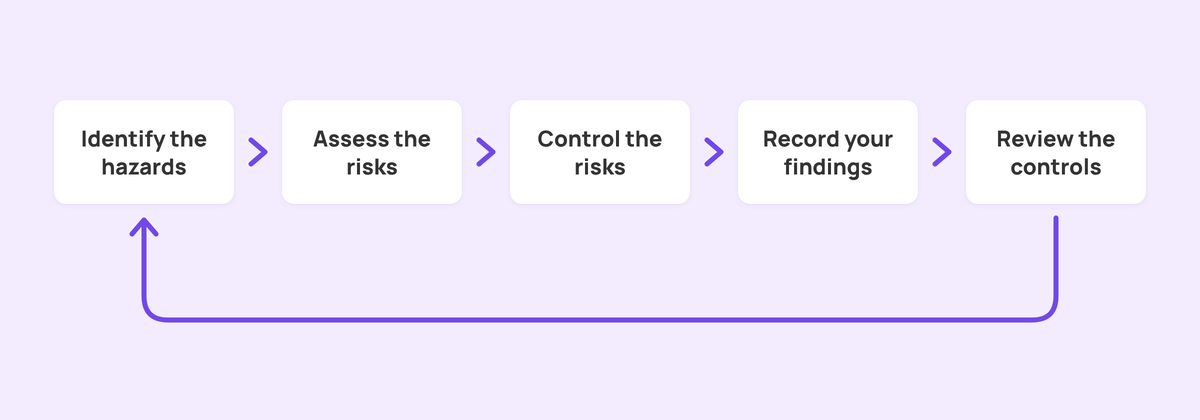
1. Identify the hazards
Walk the site and look at how people actually work. HSE suggests thinking about how equipment is used, what chemicals are on site, and the general state of the premises.
Then check the records. Accident and ill health logs point to less obvious hazards, and so do near misses. HSE also asks you to include non-routine work such as maintenance and cleaning. Talk to the people who do the job. HSE notes that they will usually have good ideas. Our list of common workplace hazards is a useful prompt for the walkthrough.
2. Assess the risks
For each hazard, think about who might be harmed, including employees, contractors, visitors, and members of the public. HSE flags some groups with particular needs, including young workers, migrant workers, new or expectant mothers, and people with disabilities.
Then judge the risk. OSHA suggests weighing the severity of the possible outcome, how likely it is, and how many workers might be exposed.
3. Control the risks
Start by asking whether you can remove the hazard altogether. If you can't, HSE lists the usual options. You can redesign the job, replace the materials or machinery, organize work to reduce exposure, and, last on HSE's list, provide personal protective equipment.
In Great Britain, you're expected to do what is "reasonably practicable," which HSE describes as balancing the level of risk against the money, time, or trouble needed to control it. Some fixes can't wait for the report. OSHA notes that housekeeping and tripping hazards "can and should be fixed as they are found."
4. Record your findings
Write down the hazards, who might be harmed, and what you're doing about them. HSE offers a free risk assessment template along with examples for offices, shops, warehouses, and other workplaces.
HSE warns against copying an example and adding your company name. The record should describe your site.
5. Review the controls
An assessment goes stale. In Great Britain, the regulations require a review when there is reason to think it is no longer valid, or after a significant change. HSE lists changes to staff, processes, substances, or equipment, and suggests a review after accidents or near misses.
That forklift and that new hire are both reasons to open the file again.
Turn the findings into a training program
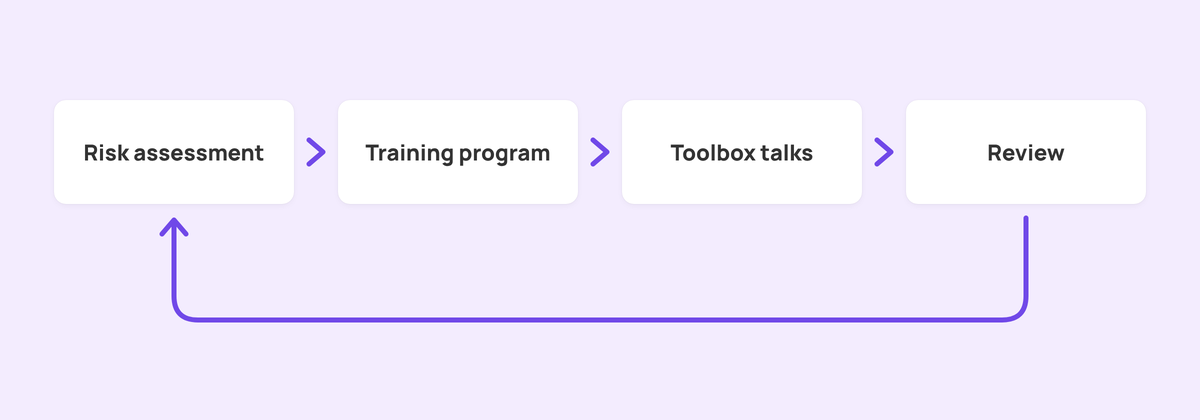
The assessment tells you what people need to know. The training program makes sure they know it.
In Great Britain, section 2 of the Health and Safety at Work etc. Act 1974 requires the information, instruction, training, and supervision needed to keep employees safe. Regulation 13 of the 1999 regulations adds the timing. Training is due when someone is recruited and when they face new or increased risks, such as a transfer, new equipment, new technology, or a new system of work. It must be repeated periodically where appropriate and take place during working hours.
In the US, many training rules sit in individual OSHA standards. The Hazard Communication standard says employers "shall provide employees with effective information and training on hazardous chemicals in their work area at the time of their initial assignment."
HSE's leaflet Health and safety training, a brief guide offers a five-step approach that's useful outside Great Britain too:
- Decide what training your organization needs, starting from your risk assessments and your injury and near-miss history.
- Set priorities, putting first the gaps that could cause serious harm, new recruits, and people with new jobs or equipment.
- Choose methods, from on-the-job coaching to classroom or computer-based learning.
- Deliver it in a way that is easy to understand.
- Check that it worked, by asking whether people are working the way they were trained.
Language matters too. OSHA's education and training guidance asks employers to provide training "in the language(s) and at a literacy level that all workers can understand." Keep records as you go, because HSE recommends using them to decide when refreshers are due.
Keep training current with toolbox talks
Regulation 13 expects training to be repeated where appropriate. Short, regular refreshers are an easy way to do that.
A toolbox talk is one of the simplest formats. OSHA's fall prevention training guide says each one should last about 5 to 10 minutes and can be given before the work shift or during breaks. It should also be participatory, so workers can ask questions and discuss the topic.
A simple rhythm looks like this:
- Pick one hazard a week from your risk assessment, starting with the highest risks.
- Use a real example from your own site, such as a near miss, a changed procedure, or a new piece of equipment.
- Ask a question and leave time for answers. OSHA notes that discussion makes people more likely to remember the information.
- Record who attended, so the talk shows up in your training records.
OSHA's guide notes that employers can train workers to lead the talks or have supervisors run them.
Where screens fit in risk assessment and training
Screens in break rooms, workshops, and loading bays can repeat what the training covered, right next to the hazard it covers. Five Fugo features help with this:
- Show the topic at shift start. Fugo playlists can run on a recurring daily or weekly schedule, or at set times and days, so a toolbox talk reminder plays as each shift begins.
- Edit slides in one place. With the Google Slides app, changes you make to a slide deck sync automatically to your screens.
- Target the right area. Publish by property lets you send a playlist to every screen with a value you define, such as Location or Department, so workshop reminders stay in the workshop.
- Set an end date. A refresher campaign can start and stop on set dates, so last month's topic comes down on time.
- Push an urgent change. A manual trigger plays a playlist on demand with a single click, which helps when a review adds a new control that people need to know about today.
For short daily messages, our list of safety quotes for work has slogans sorted by topic. If your risk assessment covers fire, weather, or other emergencies, our guide to an emergency preparedness plan covers where screens fit in a warning plan.
FAQs
What is a health and safety risk assessment?
It's a careful look at what could cause injury or ill health at work, who could be harmed, and what controls you need. In Great Britain, every employer must carry one out by law.
Is a job hazard analysis the same as a health and safety risk assessment?
No. OSHA describes a job hazard analysis (JHA), also called a job safety analysis, as a technique that focuses on the tasks in one job. A health and safety risk assessment looks at what could hurt people across a whole workplace or area and what you will do about it, so a JHA covers one job at a time.
What are the five steps of a risk assessment?
HSE lists them as identify the hazards, assess the risks, control the risks, record your findings, and review the controls.
Is a risk assessment a legal requirement?
In Great Britain, yes, and employers with 5 or more people must record the significant findings. EU employers must evaluate risks under the Framework Directive. In the US, the duty comes from the General Duty Clause, specific OSHA standards, and some state rules.
How often should you review a risk assessment?
Review it when it may no longer be valid, after a significant change, and after accidents or near misses. Changes to staff, processes, substances, or equipment are common triggers.
How often should health and safety training be repeated?
In Great Britain, training must be repeated periodically where appropriate, and again when people face new or increased risks. Some US standards set their own timing for specific hazards.
What is a toolbox talk?
It's a short safety discussion, usually 5 to 10 minutes, held before a shift or during a break. It covers one topic and gives workers time to ask questions.
Can digital signage help with safety training?
Screens can repeat the week's toolbox talk topic and show reminders in the area where a hazard sits. They support training, records, and supervision without replacing them.
Where to start
Pick one area of your site and run a health and safety risk assessment there this month, using the five steps above. Take the top three findings and turn each one into a toolbox talk.
Then put this week's topic on the screen closest to the hazard. See how Fugo handles safety signage, or start a 14-day free trial and try it on one screen.


