


Most workplace injuries come from a short list of causes. A wet floor by the loading bay, a box lifted from the wrong height, a forklift reversing past a blind corner. None of these is unusual, and that's part of the risk, because people stop noticing hazards they walk past every day.
This guide covers ten common workplace hazards, drawn from US and UK safety data, with practical steps to control each one. It ends with a short section on using the screens already in your break rooms, warehouses, and workshops to put the right reminder next to the right hazard.
How we chose these ten hazards
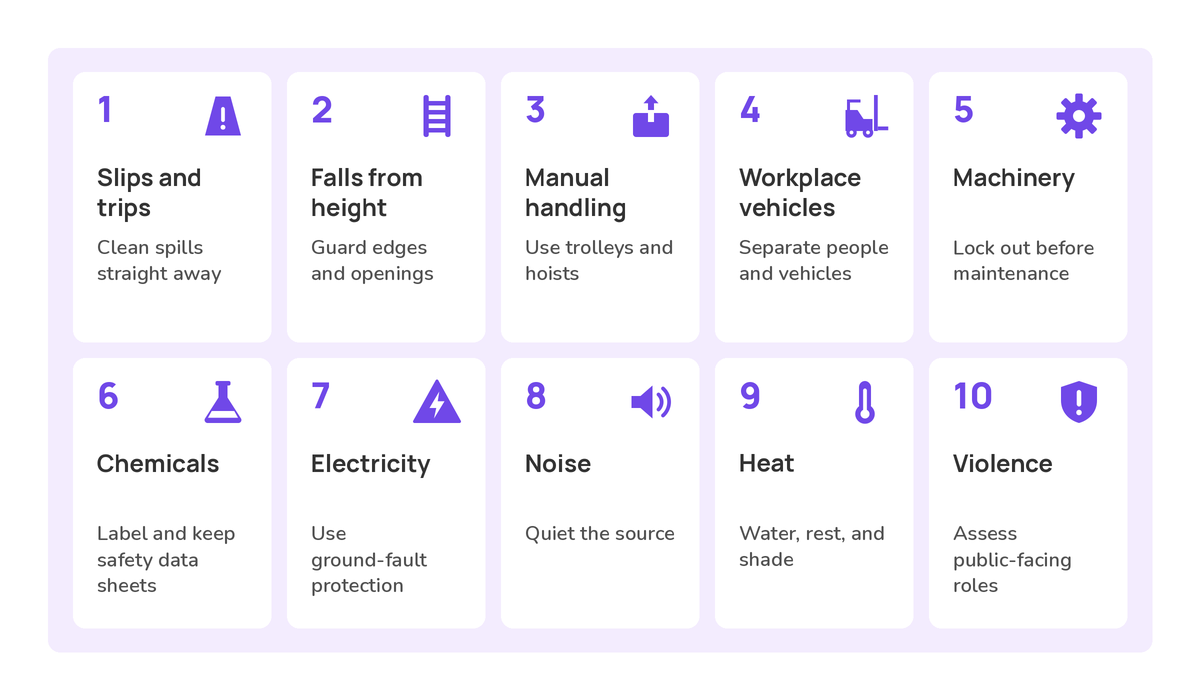
We started with injury data. In Great Britain, the Health and Safety Executive's non-fatal injury statistics show that slips, trips, or falls on the same level caused 30% of employee injuries reported by employers in 2024/25. Handling, lifting, or carrying caused 17%.
In the US, OSHA publishes its most frequently cited standards to show where inspectors keep finding problems. The preliminary list for fiscal year 2026 is led by fall protection, hazard communication, and lockout/tagout, with ladders, forklifts, and machine guarding further down. The Bureau of Labor Statistics fatal injury census recorded 5,070 fatal work injuries in the United States in 2024.
For each hazard, the steps follow the NIOSH hierarchy of controls. It has "five levels of actions to reduce or remove hazards," running from elimination and substitution through engineering and administrative controls to personal protective equipment (PPE). NIOSH adds that "Employers should not rely on PPE alone to control hazards when other effective control options are available."
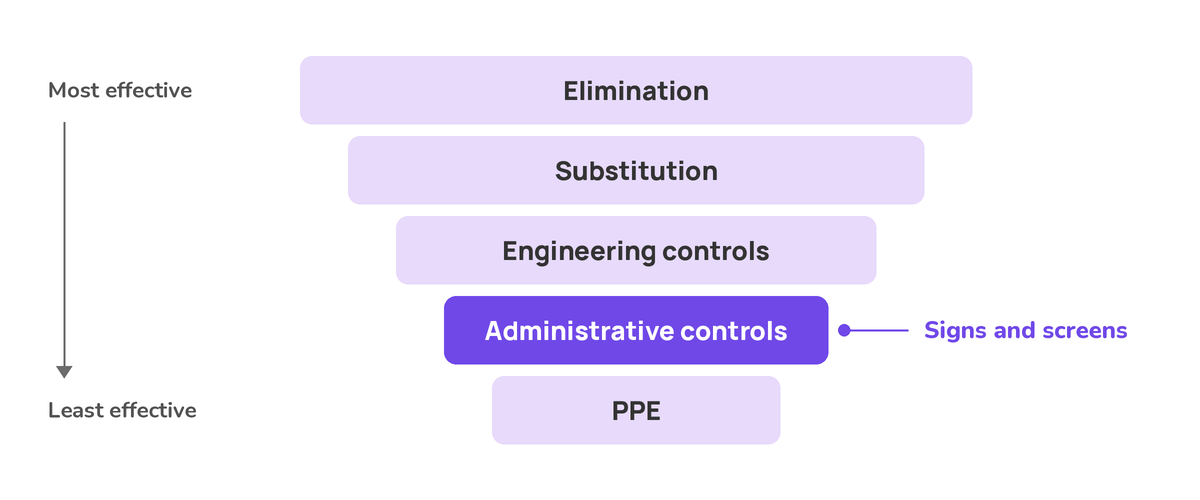
Signs and screens are administrative controls. They work best alongside the stronger measures above them.
1. Slips and trips on the same level
This is the most common cause of reported injury in the HSE figures. HSE's kind of accident statistics found it was the most common employer-reported non-fatal accident kind "across most broad industry sectors in 2024/25."
OSHA's fall protection guidance puts the basic rule plainly: "Keep floors in work areas in a clean and, so far as possible, a dry condition."
- Deal with spills straight away. Keep spill kits where liquids are used and agree who cleans up.
- Keep walkways clear. Route cables away from foot traffic and keep stock out of aisles.
- Fix lighting and flooring. Dim stairwells, loose mats, and uneven thresholds all catch people out.
- Match footwear to the floor. Kitchens and wet areas need slip-resistant soles.
HSE's slips and trips guidance goes into causes and prevention by role.
2. Falls from height
Falls from height hurt fewer people than slips and trips, but they are far more likely to kill. HSE's kind of accident statistics report that falls from a height "accounted for over a quarter of all work-related fatal injuries over the last five years." In the US, the BLS census counted 844 fatal falls, slips, and trips in 2024.
OSHA requires fall protection at "four feet in general industry workplaces, five feet in shipyards, six feet in the construction industry and eight feet in longshoring operations," according to its fall protection overview.
- Avoid working at height where you can. Use extension poles, or bring the work down to ground level.
- Guard edges and openings. OSHA tells employers to "Guard every floor hole into which a worker can accidentally walk."
- Check access equipment. Ladders and scaffolding both appear on OSHA's cited list, so inspect them before use and take damaged ones out of service.
- Train people. Fall protection training is on the list too.
3. Manual handling and lifting
HSE defines manual handling as "transporting or supporting a load by hand or bodily force." Its manual handling guidance sets out the order employers follow. First, "avoid hazardous manual handling, so far as reasonably practicable," then assess the handling you can't avoid and reduce the risk. HSE also notes that "the law does not set specific weight limits."
That means looking at the task as a whole, including how far a load travels, how often it's lifted, and how awkward it is to grip.
- Use equipment. Trolleys, hoists, and conveyors take the load off people's backs.
- Store heavy items at waist height. Lifting from the floor or above the shoulder adds strain.
- Break loads down. Smaller packs or a two-person lift beat one heavy one.
- Rotate repetitive tasks. NIOSH lists job rotation and rest breaks among its administrative controls.
4. Forklifts and other workplace vehicles
The BLS census found that "Transportation incidents continue to be the most frequent type of fatal event, accounting for 38.2 percent of all occupational fatalities in 2024." Many of those happen on public roads, but vehicles on site are a risk too. In Great Britain, HSE's kind of accident statistics show being struck by a moving vehicle caused 16% of fatal injuries to workers over the latest five-year period.
Powered industrial trucks appear on OSHA's cited list, and OSHA's forklift guidance says "Employers must ensure that each powered industrial truck operator is competent to operate a powered industrial truck safely."
- Separate people and vehicles. HSE's workplace transport guidance covers traffic routes and pedestrian separation.
- Mark routes and crossings. Use barriers where you can and floor markings where you can't.
- Manage blind spots. Fit mirrors at corners and set site speed limits.
- Check trucks daily. Run a pre-use checklist before each shift.
5. Moving machinery and hazardous energy
The riskiest moments often come during servicing and maintenance, when someone is cleaning a machine or clearing a jam. OSHA's lockout/tagout guidance explains that "the unexpected startup or release of stored energy can result in serious injury or death to workers." One of its examples is blunt: "A jammed conveyor system suddenly releases, crushing a worker who is trying to clear the jam."
Lockout/tagout and machine guarding both sit on OSHA's cited list.
- Keep guards fitted. Make bypassing a guard a disciplinary matter, and find out why people want to.
- Write a lockout procedure for each machine. List every energy source, including electrical, hydraulic, pneumatic, and stored energy.
- Train everyone in the area. OSHA says all employees who work where energy control procedures are used "need to be instructed in the purpose and use of the energy control procedure(s)."
- Test before you touch. Confirm the machine is isolated before work starts.
6. Hazardous chemicals
Hazard communication is second on OSHA's preliminary list. OSHA's hazard communication page states that "All employers with hazardous chemicals in their workplaces must have labels and safety data sheets for their exposed workers, and train them to handle the chemicals appropriately."
Respiratory protection and eye and face protection are also on the cited list.
- Keep an inventory. You can't control what you haven't listed.
- Substitute where you can. NIOSH notes that elimination, substitution, and engineering controls work better because "they control exposures without significant human interaction."
- Ventilate. Extraction at the source works better than a fan in the corner.
- Make the information easy to find. Labels should be legible and safety data sheets should be within reach of the people using the product.
- Provide the right PPE. Gloves, goggles, and respirators need fitting, training, and replacing.
7. Electrical hazards
Electricity is a risk for more than electricians. OSHA's electrical safety page points out that "office workers and sales people, work with electricity indirectly and may also be exposed to electrical hazards."
OSHA lists the most frequent causes of electrical injuries as "contact with power lines, lack of ground-fault protection, path to ground missing or discontinuous, equipment not used in manner prescribed, and improper use of extension and flexible cords."
- Leave electrical work to qualified people. Everyone else reports faults.
- Use ground-fault protection. This matters most in wet areas and outdoors.
- Check cords and plugs. Take damaged cords out of use and avoid chaining extension cords.
- Isolate before work. Treat electrical circuits as part of your lockout procedure.
8. Noise
NIOSH's hearing loss page estimates that "About 27 million workers are exposed to hazardous noise at work each year." It treats noise as hazardous "when it reaches 85 dBA or higher," and notes that "Occupational hearing loss is permanent but preventable."
Noise is a safety problem as well as a health one. NIOSH warns that "the warning beep as a forklift backs up" may be missed by workers with hearing loss.
- Measure first. A noise survey tells you which areas and tasks need action.
- Quiet the source. Maintain machinery, fit enclosures, and choose quieter equipment.
- Limit exposure. Rotate people out of loud areas.
- Provide hearing protection. NIOSH says workers exposed to hazardous noise "should have a yearly hearing test."
- Add visual warnings. In loud areas, lights and screens back up audible alarms.
9. Heat
Heat is easy to forget outside a summer heat wave. OSHA's heat overview says "Hazardous heat exposure can occur indoors or outdoors, and can occur during any season if the conditions are right." Its list of affected industries includes "Bakeries, kitchens, and laundries."
The risk factors OSHA names are "heavy physical activity, warm or hot environmental conditions, lack of acclimatization, and wearing clothing that holds in body heat."
- Write a heat plan. Decide when it applies and who checks conditions.
- Use water, rest, and shade. OSHA "encourages water, rest, and shade as prevention as well as treatment for heat-related illness."
- Schedule heavy work for cooler hours. Morning starts and shorter shifts help.
- Build tolerance gradually. New and returning workers need time to acclimatize.
- Teach the symptoms. People should know what heat exhaustion looks like and who to tell.
10. Workplace violence
Violence is a bigger risk in some jobs than others. HSE's kind of accident statistics show acts of violence caused 10% of employer-reported non-fatal injuries overall in 2024/25. In human health and social work it was the most common kind, at 29%, and in education it accounted for 20%.
In the US, the BLS census recorded 733 fatalities due to violent acts in 2024.
- Assess public-facing roles. Reception, retail, care, and lone workers face the most risk.
- Design the space. Clear sight lines, controlled entry, and a route out for staff all help.
- Set up lone working checks. Agree how and when people check in.
- Train in de-escalation. Give staff words to use and permission to walk away.
- Make reporting easy. Record every incident, including verbal abuse, and follow up.
Putting hazard reminders on screens near the hazard
Once the controls are in place, people still need reminding at the moment it counts. A printed sign is easy to stop noticing once it's been on the wall for a while. A screen can change its message by area, shift, and season, which keeps the reminder current.
A few ways to use screens you already have, with how Fugo handles each:
- Match the message to the place. Show vehicle route reminders by the loading dock, lockout steps in the workshop, and hydration reminders in the break room. When you build a playlist in Fugo, you pick individual screens or target a screen property you create, such as Area = Warehouse, so warehouse content stays on warehouse screens.
- Schedule by shift and season. Fugo playlists can run on a recurring daily or weekly schedule, or at set times and days, so a night-shift reminder only plays at night.
- Interrupt for urgent alerts. A manual trigger in Fugo takes over screens with a single click, so a spill warning, a heat alert, or an incident notice can go up the moment it's needed. Our guide to an emergency preparedness plan covers where screens fit in a wider warning plan, and emergency alerts shows the setup.
- Keep a safe default. A fallback playlist plays whenever nothing else is scheduled, so a screen shows your standing safety rules instead of going blank.
- Show the numbers. If your near-miss log or open safety actions live in a Tableau dashboard, Fugo's Tableau app keeps an up-to-date screenshot of it on screen.
- Use the languages your team reads. OSHA asks employers to "Train workers about job hazards in a language that they can understand." Our post on multilingual signage for deskless workers covers how to plan it.
For short daily messages, our list of safety quotes for work has slogans sorted by topic. Keep each screen to one hazard and one action, in large type that people can read from where they stand.
Frequently asked questions
What are the most common workplace hazards?
Slips and trips, falls from height, manual handling, workplace vehicles, machinery, hazardous chemicals, electricity, noise, heat, and violence are among the most common. The list draws on HSE injury data and OSHA's most frequently cited standards.
What is the most common cause of workplace injury?
In Great Britain, slips, trips, or falls on the same level caused 30% of non-fatal injuries to employees reported by employers in 2024/25, according to HSE.
What is the most cited OSHA standard?
Fall protection, general requirements (29 CFR 1926.501) is first on OSHA's preliminary list for fiscal year 2026.
What is the hierarchy of controls?
It's the NIOSH order for controlling hazards. Elimination comes first, then substitution, engineering controls, administrative controls, and finally personal protective equipment.
Can digital signage improve workplace safety?
Screens can show reminders and alerts next to the hazard they relate to. They're an administrative control, so they work alongside guards, safe systems of work, and training.
How do you warn workers in noisy areas?
Use visual warnings such as beacons and screens alongside audible alarms. NIOSH notes that workers with hearing loss may miss sounds like a forklift's reversing beep.
Where to start
Pick the three hazards that cause the most near misses at your site and check each control against the hierarchy. Then put one clear reminder on the screen closest to each hazard. See how Fugo handles safety signage, or start a free trial and test it on one screen.


