
Open source digital signage: an honest guide
A fair, plain-English guide to Anthias, Xibo, PiSignage and the rest — and an honest read on when self-hosting is worth it and when it isn’t.

The short version. Open source digital signage means the software is free to download and you run it yourself. The main projects are Anthias, Xibo, PiSignage and info-beamer. They are genuinely good, and for a handful of screens run by someone who enjoys the tinkering, open source is often the right answer — we mean that. The cost shows up later: a server to host, updates to apply, and a drive across town when a player stops. If you are running screens across several sites and nobody’s job title says “signage”, a hosted platform usually works out cheaper in hours, not licence fees. This page lays out both, fairly. Fugo is hosted, not open source — we say where we fit at the end and you can skip it.
Teams of every size run their screens on Fugo




























What “open source digital signage” actually means
Open source means the source code is published under a licence that lets anyone read it, run it and change it. For signage, that usually means two pieces: a server (where you upload content and build playlists) and a player (the bit running on the box behind the screen).
You download both. You run both. Nobody sends you an invoice.
Open source is not the same as free
Free means no licence fee. Open source means you get the code. They overlap, but they are not the same thing.
Plenty of signage software is free without being open source — a limited free tier, or a consumer app doing a job it was never built for. And some open-source projects sell a hosted version alongside the free code, which is a perfectly reasonable business model.
If it is the free question you are really asking, we wrote a separate honest take on free digital signage software.
Self-hosted, cloud-hosted, or both
Most open-source projects are self-hosted: the server runs on your hardware or your cloud account, and you own the uptime. Some offer a paid cloud version of the same software, so you get the open codebase without running the server yourself.
This is the single biggest fork in the road, and it is not really about open source at all. We broke it down in cloud vs on-premise digital signage.
The main open source digital signage projects
A quick, fair tour. Every claim below is worth checking against the project’s own site before you commit — these things move.
Anthias (formerly Screenly OSE)
Anthias is the project most people land on first. Worth knowing up front: Anthias is Screenly’s own open-source project. It used to be called Screenly OSE, and it sits on a Screenly subdomain. That does not make it worse software — it is well known and widely used — but it is not a neutral third party, and the route from Anthias to Screenly’s paid product is a deliberate one.
It is built around the Raspberry Pi and it is deliberately simple: a playlist of images, videos and web pages on a screen. If that is genuinely all you need, it does that job well.
Xibo
Xibo is the biggest and most feature-rich project in this space — scheduling, layouts, user permissions, the lot. It has been going a long time and has a real community behind it. It also has more moving parts than Anthias, so expect a longer first afternoon.
Our wiki has a plain-English explainer of the Xibo player if you want the short version.
PiSignage
PiSignage is another Raspberry Pi–centred project, with a free self-hosted option and paid hosted tiers. Popular with people who already have Pis on the shelf. See our PiSignage player entry.
info-beamer
info-beamer is known for slick, smooth graphics on the Pi and is a favourite for installations and events. Check the licensing carefully: the open-source and commercial parts are split, and the split is not what people assume.
Others you will run into
Names that come up in the same conversations include Screenlite, Garlic Signage and Concerto. We have not tested them and will not pretend otherwise — check they are still maintained, and check the licence, before you build anything on one.
What open source genuinely does well
Not a warm-up before the catch. These are real advantages.
- No licence fee, no seat maths. Add a tenth screen, add a hundredth. The software cost stays zero.
- You can change it. Need an odd data feed, a strange screen shape, a niche integration? You have the code. No roadmap to wait on.
- Nobody can take it away. No vendor going out of business, no plan you relied on being retired.
- Your data stays where you put it. For some organisations that ends the conversation, and fairly so.
- Cheap hardware, and plenty of it. These projects run happily on a Raspberry Pi that costs less than a month of most platforms.
- Real communities. Forums, GitHub issues, people who have solved your exact problem and written it up.
What it actually costs
Open source moves the cost. It does not delete it.
Somewhere to run the server
Self-hosting needs a machine that is always on. Add storage for your media, backups you have actually tested, and a way in from outside if your screens are not all on one network.
Your time, which is the big one
Installing it is the easy part. The ongoing bill is small and constant: applying updates, fixing a player that stopped after an OS update, working out why one screen went black at the weekend. An hour here and an hour there, forever, and it lands on whoever set it up.
Updates and security patching
Self-hosted means you own the patching. Server, player OS, dependencies, certificates. A screen facing the public that has not been patched in two years is a genuine risk.
Getting to the device
The cost people never budget for. When a player locks up in a building forty minutes away, somebody drives there. Multiply by sites, then by how often it happens.
Compliance, if it applies to you
If you need SOC 2 Type II, HIPAA handling or GDPR paperwork, self-hosted means you are the one producing the evidence. Achievable. Also a project.
None of this makes open source a bad choice. It makes it a choice with a different bill — paid in hours rather than invoices. Work out your hourly cost and the maths gets clear quickly.
When open source is the right answer
Genuinely, go this route if:
- You are running a handful of screens, mostly in one building.
- Somebody on the team enjoys this kind of work and has the hours.
- Your content is straightforward — images, a web page, a short video loop.
- Your data must not leave your network, full stop.
- You need something so specific that only editing the code will do it.
- It is a pilot, a classroom, a maker space, or a proof of concept.
If several of those are true, stop reading and go download Anthias or Xibo. You will be fine, and you will spend nothing.
When a hosted platform makes more sense
The balance usually tips when:
- Screens are spread across several sites and you cannot walk to them.
- The person who set it up has a different day job — or has left.
- You need scheduling and day-parting that works without anyone remembering.
- Screens are showing live dashboards that must stay logged in and current.
- Downtime has a cost — a blank menu board, a dark reception screen.
- Procurement wants a signed SOC 2 Type II report rather than your own paperwork.
- You are running a mixed fleet of hardware and want one place to see all of it.
Where Fugo fits — and where it doesn’t
Fugo is not open source. It is a hosted platform, priced per screen, and you cannot download the code. If open source is a hard requirement, Fugo is not your answer, and one of the projects above will serve you better.
What you get for the fee is the work you would otherwise do yourself:
- Hardware-agnostic. Amazon Fire TV and the Signage Stick, Google TV Streamer, NVIDIA Shield, Android boxes, Samsung Tizen and LG webOS built-in players, Windows and ChromeOS. Run a mixed fleet from one place. See the player comparison.
- Design Studio and templates for building content in the browser, plus playlists, scheduling and day-parting.
- Remote multi-site management — group and tag screens by site, push changes without visiting them.
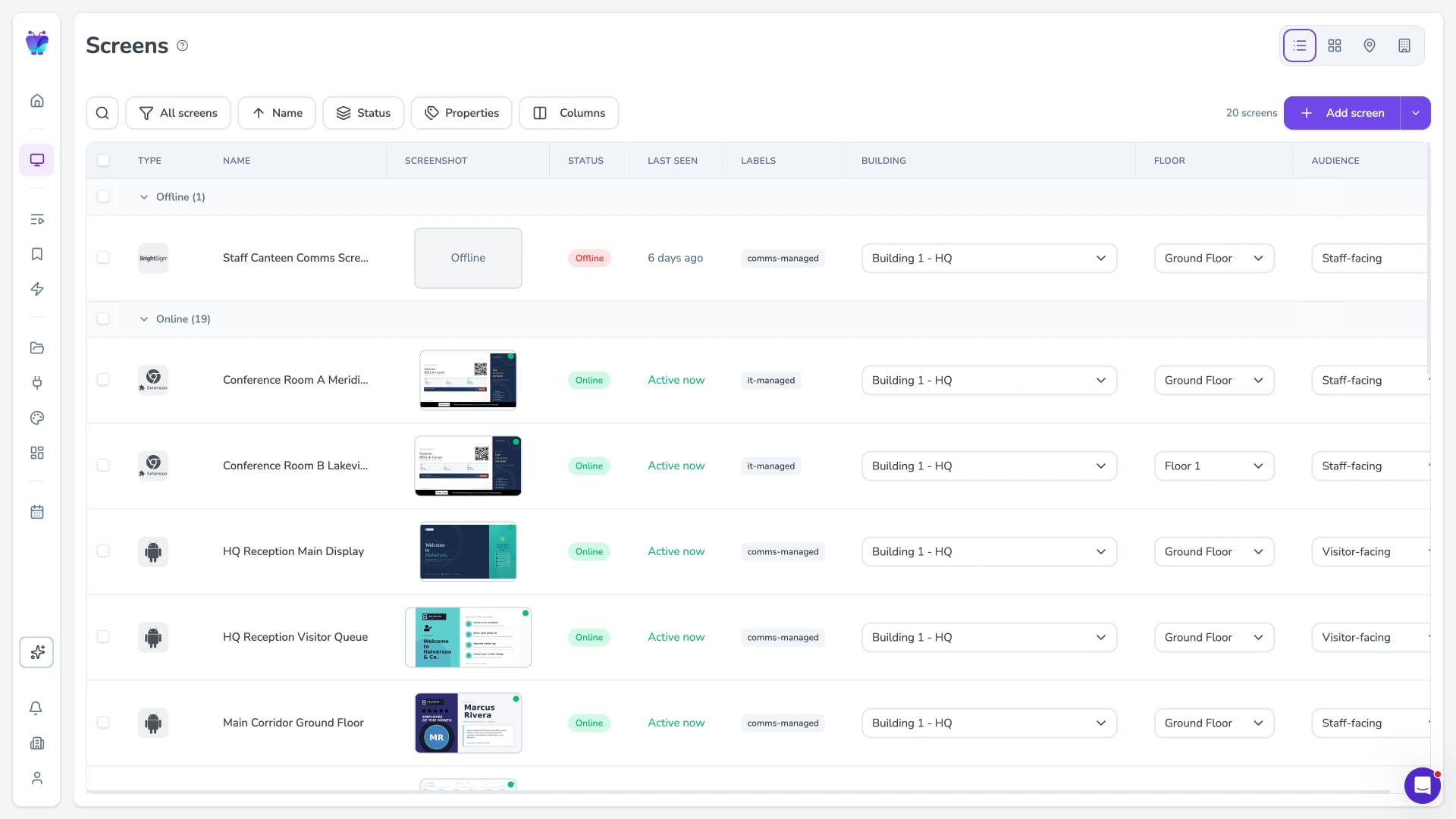
- Uptime monitoring and remote recovery — see what is offline, pull a remote screenshot to check what is actually on the wall, and recover a screen without driving to it. This is the line item that replaces the site visit.
- Dashboards on TV for live data, with logins that persist.
- Integrations including Canto DAM, so content comes from where it already lives.
- SOC 2 Type II, with per-screen pricing — see the full digital signage software features.
Being straight about the gaps: Fugo has no importer for Anthias, Xibo or PiSignage content. If you move, you re-create your playlists. It is usually an afternoon, but it is an afternoon, and we would rather you heard that from us.
If you are on a Raspberry Pi now
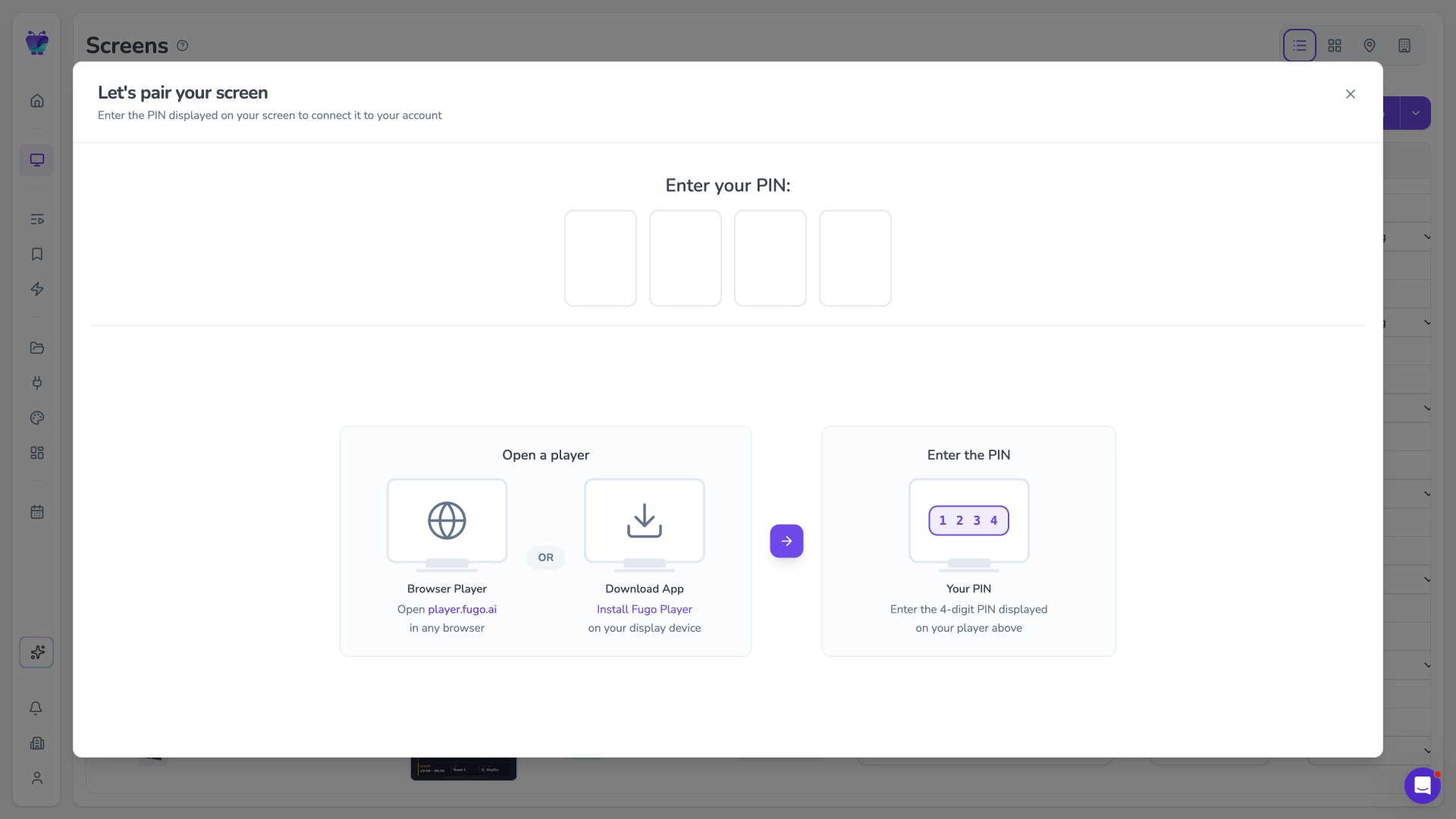
Plenty of people reading this are running open-source signage on a Pi. You can keep the Pi and change the software — Fugo runs on Raspberry Pi 4 and 5 from a pre-configured image you flash to an SD card. It boots straight into the player and pairs with a PIN.
The honest limits, because you will hit them either way: video playback on a Pi is not especially smooth, multi-zone layout performance is poor, and multi-zone layouts and website scripting are not supported on Pi. Some App Store apps will not render smoothly. Pi 1, Zero and Zero W are not supported at all. It is a great low-cost player for images, text and simple layouts — and remote screenshots and remote updates do work on the Pi, which is the bit self-hosting makes hard. Full detail on Raspberry Pi digital signage.
A quick way to decide
Count three things:
- 1Screens. Under ten, in one building? Open source is very reasonable.
- 2Sites. More than two, and remote recovery starts paying for itself.
- 3Hours. Whose are they, and what are they worth? Multiply by twelve months.
If the hours cost more than the subscription, you have your answer. If they don’t, go and enjoy Xibo.
Not sure which side of the line you’re on?
Show us your screens and your sites and we will tell you straight — including if open source is the better fit for you.