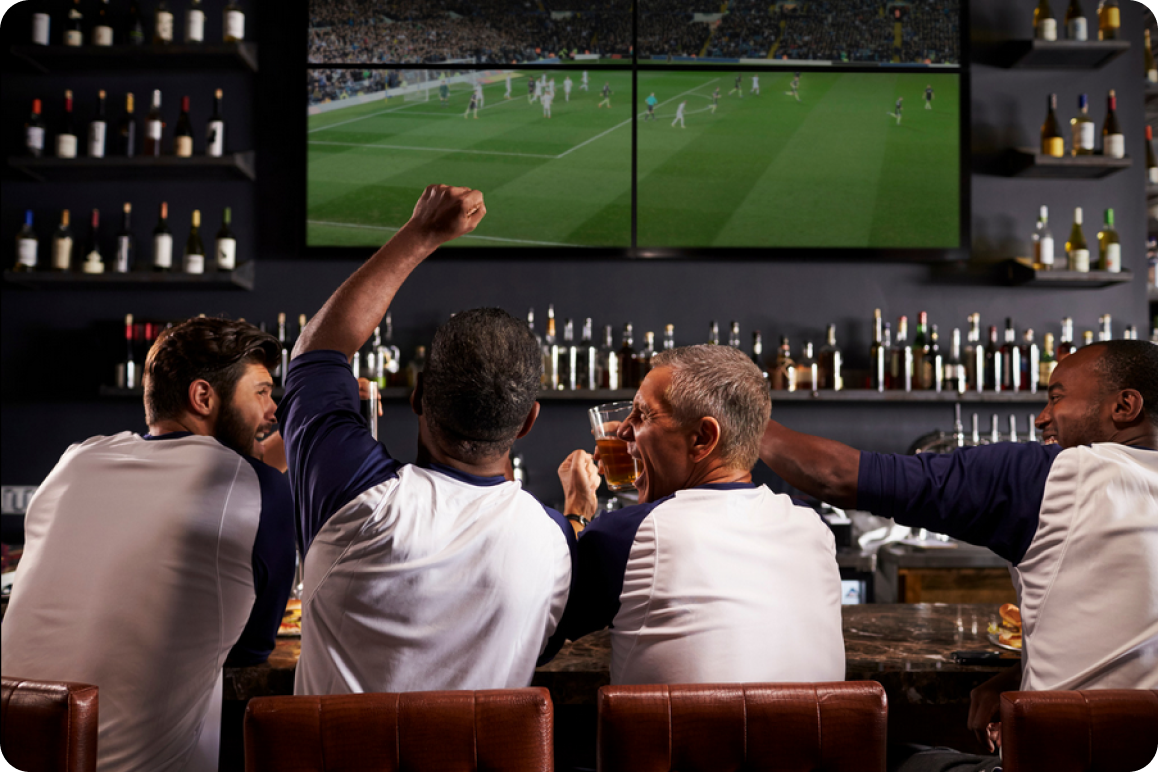
It's Saturday afternoon. Your bar has twelve screens, four matches worth showing, and the rights to those four matches sit with three different providers — two of which no longer broadcast by satellite at all.
This is the position a growing number of sports bars and pubs now find themselves in. We've seen a marked increase in venues coming to Fugo with a version of the same question: live sport is moving to streaming platforms, our AV setup was built for satellite, and we don't know what to replace it with.
This guide covers what's actually changing, why streaming behaves differently from broadcast in ways that matter on a busy Saturday, the three architectures venues use to solve it, and what it costs to build.
What is OTT, and why does it matter to a venue?
OTT — over-the-top — means video delivered over the public internet, independent of any managed network. Sky Stream, DAZN, Prime Video and Netflix are all OTT services. You need a connection and an account; nobody has engineered the path between their servers and your building.
Broadcast — satellite and terrestrial — is the opposite. A dedicated one-to-many transmission path, engineered end to end. Adding a screen adds no load, because every receiver pulls from the same signal in the air.
IPTV sits between the two: television delivered over IP, but across a managed, controlled network rather than the open internet. A hotel distributing channels to every room over its own infrastructure is running IPTV.
That distinction is the root of nearly every problem in this guide. Broadcast doesn't care how many screens you have. OTT does — each screen is a separate connection competing for the same finite pipe into your building. Understanding that one difference explains the bandwidth, synchronisation and latency issues covered below.
One note on terminology: search for "IPTV" and most results are unlicensed subscription services rather than the technology described here. This guide is about legitimate venue infrastructure and licensed content — the two are unrelated despite sharing a name.
The shift is already underway
This isn't a forecast. It is happening now, on published timelines.
Broadcast infrastructure has an end date. The UK government published a green paper in 2026 setting out plans for terrestrial television switch-off, dependent on broadband rollout. A Sky-backed study argued Freeview could realistically be switched off by 2034, with roughly 330,000 households needing targeted support. Sky's own departure from the Astra 28.2°E satellite position is scheduled for the end of 2029.
Providers are already moving. Sky Glass and Sky Stream are internet-only products, and Sky no longer sells the Sky Q satellite box to new customers through its online store. Sky, the BBC, ITV and Channel 4 are all pushing toward IP delivery.
Rights are fragmenting, fast. Streaming services will spend an estimated $14.2 billion on sports rights in 2026. Prime Video has overtaken DAZN as the largest streaming spender, taking 27% of streaming sports spend against DAZN's 22% — driven in part by the first full year of its eleven-year, $1.8bn-per-season NBA deal. Generalist streamers as a group — Prime Video, Netflix, Paramount+, Disney+ and Apple TV — will account for 44% of streaming sports rights spend in 2026, up from 31% the year before.
For a venue, that last point is the one that bites. There is no longer any single provider whose package covers a full weekend of fixtures. Where a bar once needed one satellite subscription, it now needs a way to pull from several sources — some of which have never had a satellite feed at all.
And the commercial pressure runs the other way at the same time. Some UK venues report annual sports packages reaching around £30,000, with several pulling out of televised football altogether on cost grounds. Fragmentation is arriving alongside rising prices, not instead of them.
How venues do it today — and where it breaks
One receiver per screen
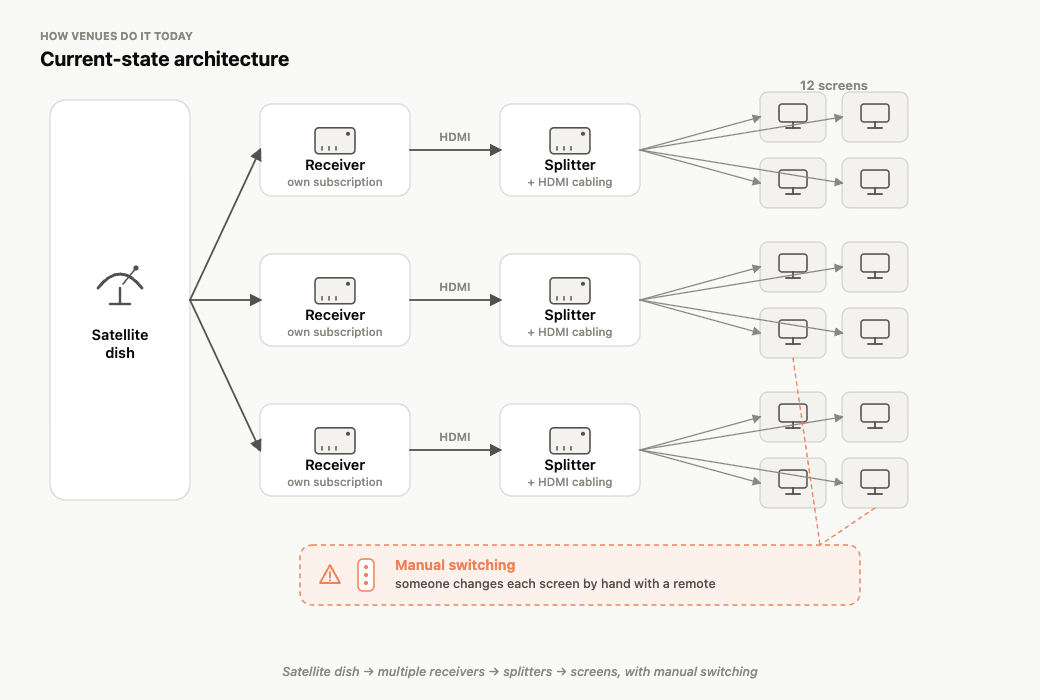
The textbook setup. Every screen gets its own box and its own subscription line. It works, it's clean, and it's the most expensive option available. It also locks the venue to whichever provider the boxes belong to — which matters more every season as rights spread out.
Fewer boxes than screens
The common real-world compromise. A venue buys two or three receivers and uses HDMI splitters and encoders to push those feeds to a larger number of screens, showing as many distinct channels as it has boxes.
It reduces subscription cost, but it produces a complex AV installation that is awkward to operate — changing what's on a given screen means physically working the source equipment — and it doesn't remove the single-provider lock-in. It also raises licensing questions that depend entirely on the terms of the specific commercial agreement in place. See the licensing section below.
Manual channel switching
Whatever the source topology, someone behind the bar is holding a remote. This is workable at four screens and unmanageable at twelve, particularly during the fifteen minutes when everything kicks off at once.
"Just put the app on a smart TV"
The obvious first response to the OTT shift, and the one that fails most instructively. Each screen needs a smart TV or media player, an internet connection, an account, and a subscription. Someone has to walk to each screen to change anything. Consumer subscriptions carry concurrent-stream limits that a venue will hit quickly. And as screens are added, playback degrades — buffering first, then freezing — as the building's bandwidth is exhausted.
That last failure is worth understanding properly, because it's the one that surprises people.
The five technical problems
1. Hardware
Running an OTT source on a screen requires either a smart TV capable of running the app or an external media player. For a twelve-screen venue that's twelve devices to buy, provision, connect and maintain — plus accounts and subscriptions to manage per device, and concurrent-stream caps to work around.
2. Bandwidth
The most consequential and least understood constraint. Each screen streaming independently opens its own connection, and those connections add up.
| Format | Codec | Bitrate per stream |
|---|---|---|
| 720p | H.264 | ~1.8 Mbps |
| 1080p60 | H.264 | 6–8 Mbps |
| 4K | HEVC | 15–25 Mbps |
Twelve screens at 1080p60, each pulling its own stream, needs roughly 72–96 Mbps sustained — before card payments, guest wi-fi, back-office systems or anything else touches the connection. Move to 4K and the same twelve screens want 180–300 Mbps.
The fix is multicast. Instead of sending a separate copy of the stream to every screen, the network distributes a single stream to all of them. Bandwidth consumption stops scaling with screen count — twelve screens on one channel cost the same as one. This requires network switches with IGMP snooping and a source that can be distributed on the LAN, which is precisely what the architectures in the next section are built to provide.
This is the single strongest technical argument for building a proper distribution layer rather than putting apps on TVs.
3. Synchronisation
In a bar, screens are visible from the same seat. If screen three is four seconds ahead of screen seven, half the room cheers a goal before the other half sees it. Uniformly delayed is fine; unevenly delayed is not — it's actively worse than a single screen.
Independent streams drift apart naturally. Each device buffers separately, starts at a different moment, and recovers from network hiccups on its own schedule. Nothing holds them together unless something is built to.
Fugo's Video Stream app handles this with a proxy server and a synchronised-playback toggle, which aligns playback timing across screens showing the same source.
 Fugo
Fugo
4. Latency
Streaming and broadcast don't arrive at the same time. OTT delivery typically runs 2–18 seconds behind live, with sub-10 seconds the industry target for 2026. Roughly four seconds of drift is generally considered the tolerance ceiling before the experience suffers.
The gap is closing faster than most people assume — during the 2025 NFL final, selected OTT platforms achieved lower average latency than cable feeds, the first time this happened at scale.
For a venue, the risk isn't absolute latency, it's mixing sources. A satellite feed on one screen and an OTT feed on the next, showing the same match, will not align — and the difference can be considerable. Any venue running a hybrid setup needs to plan for this rather than discover it during a cup final.
5. Subscription and channel management
The operational problem underneath all of the above: deciding which screen shows which source at which time, and making that change without walking the floor with a remote.
This is a scheduling problem, and it's the one a content management system exists to solve. A Sunday fixture list should be configurable in advance — screen one takes the early kick-off, screens two through five take the 3pm, the corner screen shows the in-house promo reel until the evening match starts.
Three architectures
The end state most venues want: a system that can take any source — OTT, satellite, cable, or a direct stream URL — and decide centrally which screen plays what, and when.
An OTT distribution setup has three parts:
- Hardware — screens and media players, connected to the network
- Infrastructure — encoders, a server where needed, and a local network capable of carrying the traffic
- Software — a CMS that tells each screen which source to play, how, and when
Each source type needs its own path into that system.
Architecture A: direct HLS link
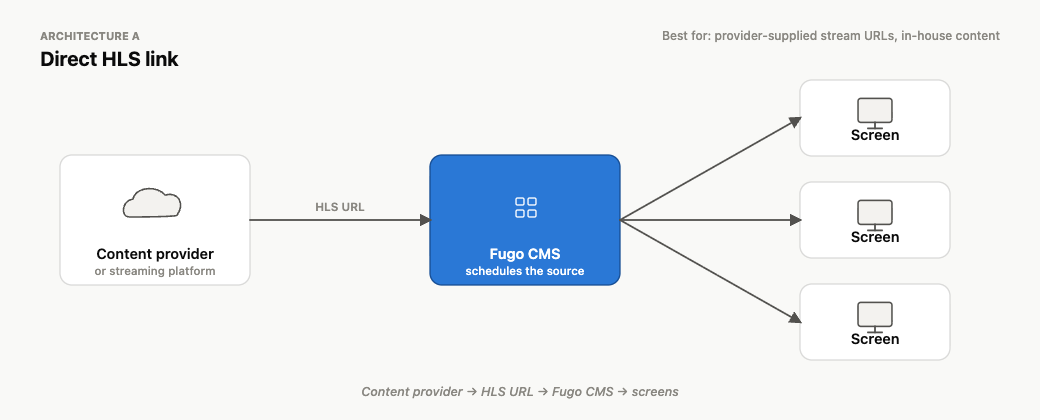
The simplest case. Some content is available as a direct HLS (HTTP Live Streaming) URL, supplied by the rights holder or the streaming company, and occasionally available free. Where that's true, the URL goes straight into Fugo's Video Stream app and the screen plays it.
Two constraints apply. Bandwidth: every screen pulling the URL independently runs into the arithmetic above. Synchronisation: independent streams drift, so sync needs to be configured deliberately.
Best for: venues with access to provider-supplied stream URLs, and for in-house content.
Architecture B: encoder from a licensed source
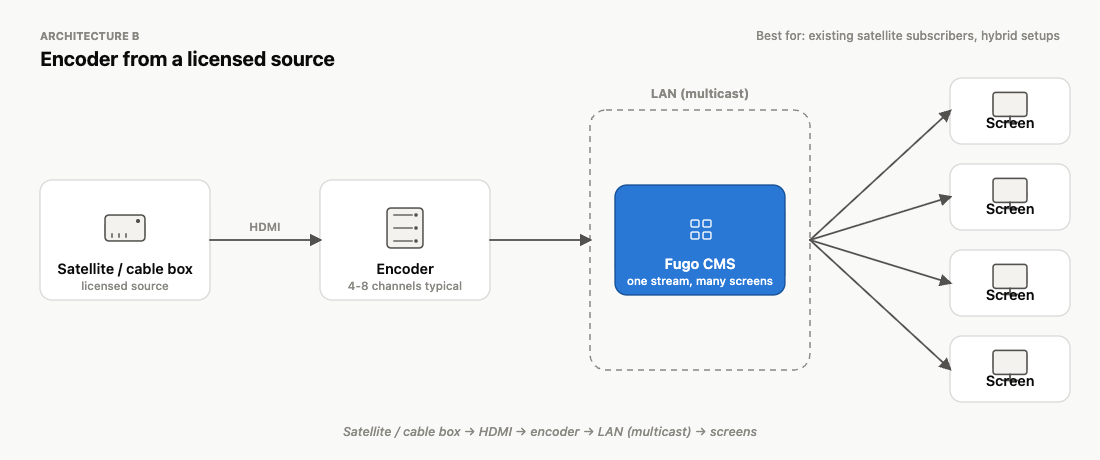
For content that only exists as a satellite or cable feed. A video encoder takes HDMI input from the receiver and distributes it across the local network, where any screen can pick it up.
Multi-input encoders are standard equipment in hospitality — four- and eight-channel units are common, and a single unit can typically handle two 4K channels or four to five 1080p60 channels depending on model. The number of independent channels the venue needs determines whether that means one multi-input encoder or several units.
This is the path for venues already paying for a commercial satellite package: it keeps the existing licensed source and replaces the splitter-and-remote layer with network distribution and central control.
Best for: existing satellite subscribers, and any venue mixing broadcast with streaming.
Architecture C: server-hosted OTT client, distributed on LAN
Important: This architecture very likely conflicts with the terms of service of most OTT platforms, and may conflict with rights agreements depending on jurisdiction and contract. It is described here because venues ask about it and should understand what it involves — not as a recommendation. Verify the position with your provider and your own legal advice before deploying anything along these lines.
The hardest case, and the reason it exists: most OTT services expose no stream URL and no API. Content is only reachable through the platform's own client application. There is nothing to point an encoder or a CMS at.
The architectural answer is to run the client on a server within the venue and distribute its output across the local network, in the same way an encoder distributes an HDMI feed. Capacity is bounded by server specification. The advantage over per-screen apps is the same as everywhere else in this guide: one source on the network rather than one connection per screen, which is what makes bandwidth optimisation and synchronisation possible at all.
The caveat above is not boilerplate. Platform terms in this area are restrictive and enforcement is active.
Mixing sources
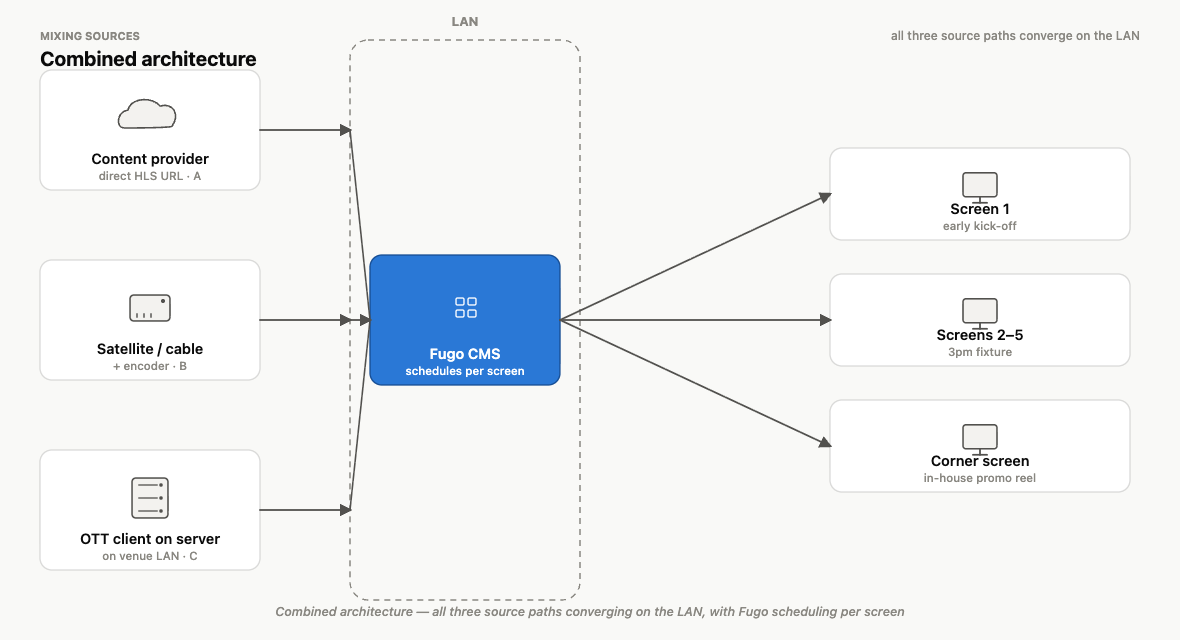
In practice, most venues need more than one of the above. The value of the distribution layer is that once each source is on the network, the CMS treats them identically — an encoder channel, an HLS URL and an in-house promo reel are all just sources to schedule against screens.
That also unlocks the things broadcast never allowed: overlaying venue branding or promotions on live content, and filling downtime between matches with your own content instead of dead air or an idle channel.
Licensing
One principle holds everywhere: a domestic subscription never covers commercial premises. Home subscriptions to any provider — satellite, cable or streaming — cannot lawfully be used to show content in a venue. This is true regardless of which architecture above is deployed, and it is the first thing to resolve before any hardware is bought.
United Kingdom
Commercial packages are available from Sky Business, TNT Sports Business and DAZN. Sky Business and Netflix launched a partnership this year allowing hospitality venues across the UK and Ireland to show selected live events, provided the operator holds a valid commercial licence — an early sign of streaming-native content becoming properly available to venues.
Pricing is generally assessed on the venue's rateable value, reflecting size and location. Costs vary widely, with some venues reporting annual packages around £30,000.
Enforcement is active and expensive. FACT works directly with Sky Business to identify premises broadcasting without a commercial viewing agreement, and recent outcomes include:
- Dolphin Inn, Llanymynech, Powys — licensee found guilty of two offences in June 2026, ordered to pay £19,000 in total (two £2,500 fines, £2,000 victim surcharge, £12,000 costs)
- Rollers Arms, Wrexham — licensee found guilty in absence of three offences in July 2026, fined more than £4,500
- A separate case resulting in a £24,000 penalty
Civil proceedings are also possible alongside criminal action.
United States
Commercial arrangements are available through DirecTV for Business and commercial agreements with ESPN and other rights holders. The enforcement model differs from the UK, and requirements vary by content type and venue.
What you actually need to buy
| Component | Notes |
|---|---|
| Media player or smart TV per screen | Fugo runs on most screens, TVs, sticks and boxes |
| Video encoder | Channel count driven by the number of independent broadcast sources; 4- and 8-channel units common in hospitality |
| Server | Only required for Architecture C; spec determines channel capacity |
| Network switches | Must support IGMP snooping for multicast — this is not optional if bandwidth matters |
| Internet uplink | Size for peak concurrent load, with headroom for POS and guest wi-fi |
| Cabling | Wired to every screen position wherever possible; wi-fi is a poor fit for sustained video |
| CMS | Fugo, for source scheduling and per-screen control |
FAQ
Can I use my home Sky or streaming subscription in my pub?
No. Domestic subscriptions do not cover commercial premises. You need a commercial agreement from the provider holding the rights to the content you want to show.
How much internet speed do I need for ten TVs?
If every screen streams independently, roughly 60–80 Mbps sustained for 1080p60, plus headroom for other business systems. With multicast distribution, bandwidth stops scaling with screen count entirely.
Why are my TVs showing the game at different times?
Independent streams buffer and drift separately. Synchronised playback has to be configured deliberately — it doesn't happen by default. Mixing satellite and OTT sources for the same match will also produce a visible gap.
Can I show Netflix in my bar?
Selected live events, via the Sky Business and Netflix partnership, provided you hold a valid commercial licence. General Netflix catalogue content is a different question — check the terms.
Do I need a smart TV for every screen?
No. An external media player works on any screen with an HDMI input, and is usually easier to standardise and maintain than a mixed estate of smart TVs.
Is satellite going away?
Not immediately, but it has published end dates. Sky leaves Astra 28.2°E at the end of 2029, and terrestrial switch-off is under active government consideration with 2034 discussed as a realistic date for Freeview.
Where this leaves you
The direction of travel is settled. Rights are fragmenting across more platforms every season, the platforms winning them are increasingly streaming-native, and the broadcast infrastructure venues built their AV around has a published expiry date.
The venues handling this well aren't the ones that bought the most subscriptions. They're the ones that stopped treating each screen as an independent television and started treating the whole estate as one system — sources on a network, screens as displays, and software deciding what plays where.
That's the layer Fugo provides.