
Start with what matters to your screens
OptiSigns is a capable, hardware-flexible product with a generous free tier and a lower entry price than ours, and we say so. Teams usually come to Fugo when the add-ons and caps start to bite — storage per screen, seats on an entry plan, a charge per video wall — and when they want live data on screens without a browser extension holding their dashboard logins. Where we could not verify an OptiSigns detail, we leave the row open rather than guess.
Run on Fire TV, the Signage Stick, Samsung Tizen, LG webOS, Windows, Linux or a ready-made Fugo player.
Put live Power BI, Tableau and Grafana dashboards straight on the TV, from the Core plan up.
Recover a frozen screen remotely instead of driving to another building.
Fugo vs optiSigns at a glance
Fugo and OptiSigns both cover the fundamentals well. This table only compares points we can verify on both sides — where we could not verify an OptiSigns detail, the cell says so instead of guessing. OptiSigns details come from our own researched breakdown of their plans and pricing (August 2026) and can change, so check optisigns.com for the latest.
Plans & pricing | ||
Free option OptiSigns’ free plan covers up to 3 screens with 1GB of storage and OptiSigns branding on screen. Fugo’s 14-day trial has full Core access, and one watermarked test screen stays free for the life of the account. | 14-day trial + 1 free watermarked screen | Free for up to 3 screens |
Starting price | $24/screen/mo monthly, $20 annual | $10/screen/mo monthly, $9 annual (Standard) |
Plan tiers (per screen / month, monthly) OptiSigns tiers are from our OptiSigns pricing guide (August 2026); Fugo tiers are from our pricing page. Both platforms gate features by tier — the rows below show where. | Essential $24 · Core $36 · Enterprise $40 (Enterprise is annual only) | Standard $10 · Pro $12.50 · Pro Plus $15 · Engage $30 · Enterprise $45 |
Enterprise screen minimum OptiSigns requires 25 screens minimum to reach its Enterprise tier. Fugo has no screen minimum on any plan. | No screen minimum | 25 screens minimum for Enterprise |
Hardware | ||
Runs on hardware you already own | ||
Amazon Fire TV support | ||
Windows & Linux support | ||
Raspberry Pi support | ||
Plug-and-play player available OptiSigns player prices from our OptiSigns pricing guide. Fugo players are quoted separately — see our hardware page. | Fugo NUC & Chromebox (quoted) | OptiStick $79.99 · Pro $299.99 · ProMax $599.99 |
Content, storage & seats | ||
Drag-and-drop content editor | ||
Template library | ||
App integrations | 40+ free apps, plus premium apps | 100+ apps on Standard, 25 on Free |
Media storage OptiSigns caps cloud storage at 1GB on the free plan and 10GB per paid screen. Fugo includes unlimited uploads in any format on every plan. | Unlimited uploads, any format | 1GB on Free, 10GB per paid screen |
User seats OptiSigns limits the Standard plan to 25 users and unlocks unlimited users on Pro Plus. Fugo includes unlimited users and unlimited spaces on every plan. | Unlimited users on every plan | Up to 25 on Standard, unlimited on Pro Plus |
Video walls OptiSigns lists video walls as a $25/month add-on, alongside separate charges for wireless presentation ($20/month) and background music ($15/user/month). Fugo includes custom-resolution video walls from the Core plan. | Included from Core | $25/month add-on |
Security & admin | ||
How dashboard credentials are handled Fugo uses a read-only service account and API token, stored encrypted, and sends only the rendered dashboard image to the player. OptiSigns uses a browser extension to record login steps and replay them on the screen. See our Grafana on a TV guide. | Read-only service account + API token | Browser extension records and replays login steps |
Single sign-on (SSO) Both platforms gate SSO. OptiSigns adds SAML and Microsoft SSO on Pro Plus; Fugo includes SSO, IdP-initiated SSO and audit logs on Enterprise. | Enterprise plan | Pro Plus and up (SAML, Microsoft SSO) |
Signage that does more than play a loop
These are the capabilities teams most often move to Fugo for.
Live dashboards from the tools you use
Power BI, Tableau, Grafana, Looker, Salesforce, HubSpot, Zendesk and Splunk play live on your screens and keep refreshing. Included from the Core plan up, with on-premise dashboards on Enterprise.
Dashboards without handing over passwords
Fugo connects through a read-only service account and API token, stored encrypted, and sends only the rendered dashboard to the player — no browser extension recording your login steps.
Screens you can fix without a site visit
Fugo watches every screen for uptime and can recover a frozen player remotely, so a blank screen in another building is not a site visit.
Ask Fugo — built-in AI
Find content, build layouts and take actions with natural language, right inside the dashboard.
Design Studio
Design once on a flexible canvas with zones, apps and live data, then reuse it as a company template across every location.
No per-feature add-ons
Unlimited uploads, unlimited users and unlimited spaces come as standard, video walls are included from Core, and there is no screen minimum on any plan.
Enterprise-ready security
Fugo is SOC 2 Type II, SOC 3 and HIPAA compliant, with role-based permissions on every plan, and SSO plus audit logs on Enterprise.
See Fugo in action
Real screens from the Fugo dashboard — not mock-ups.
Manage every screen from one dashboard
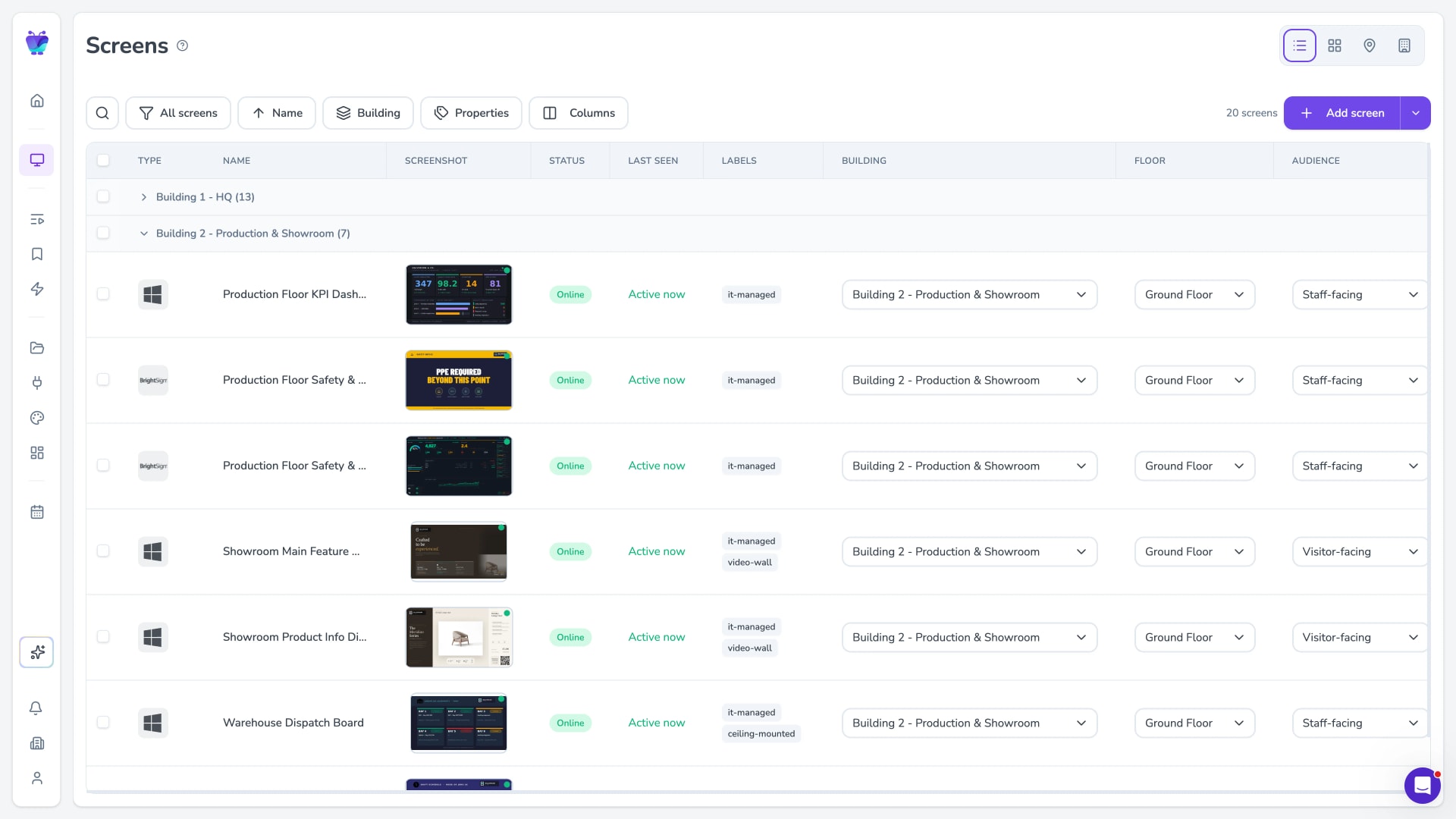
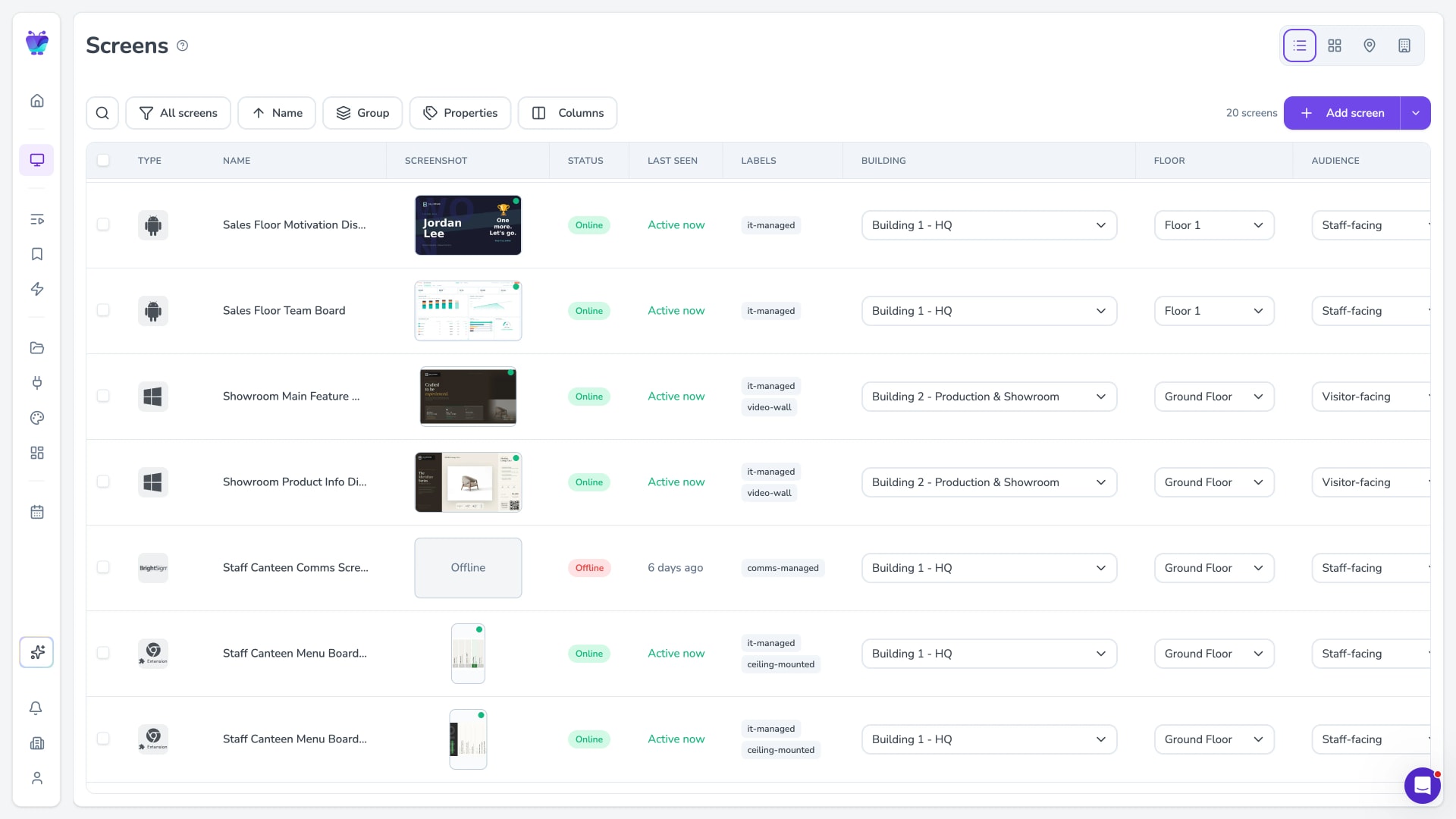
See what is playing across every location, filter by status, and publish to a group in a couple of clicks.
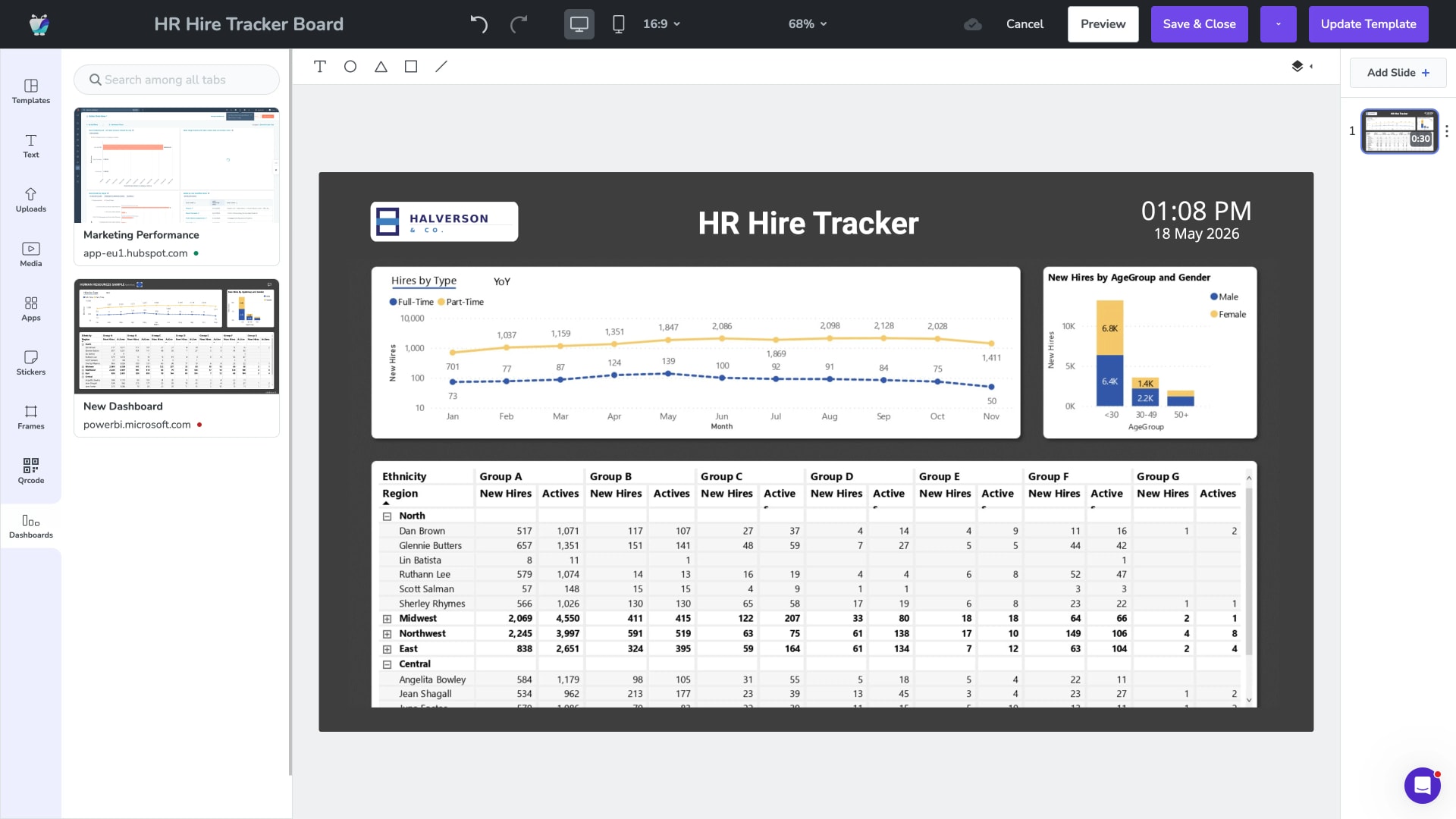
Live data on the screen
Drop a Power BI or Tableau dashboard onto the canvas and it keeps refreshing on the TV on its own.
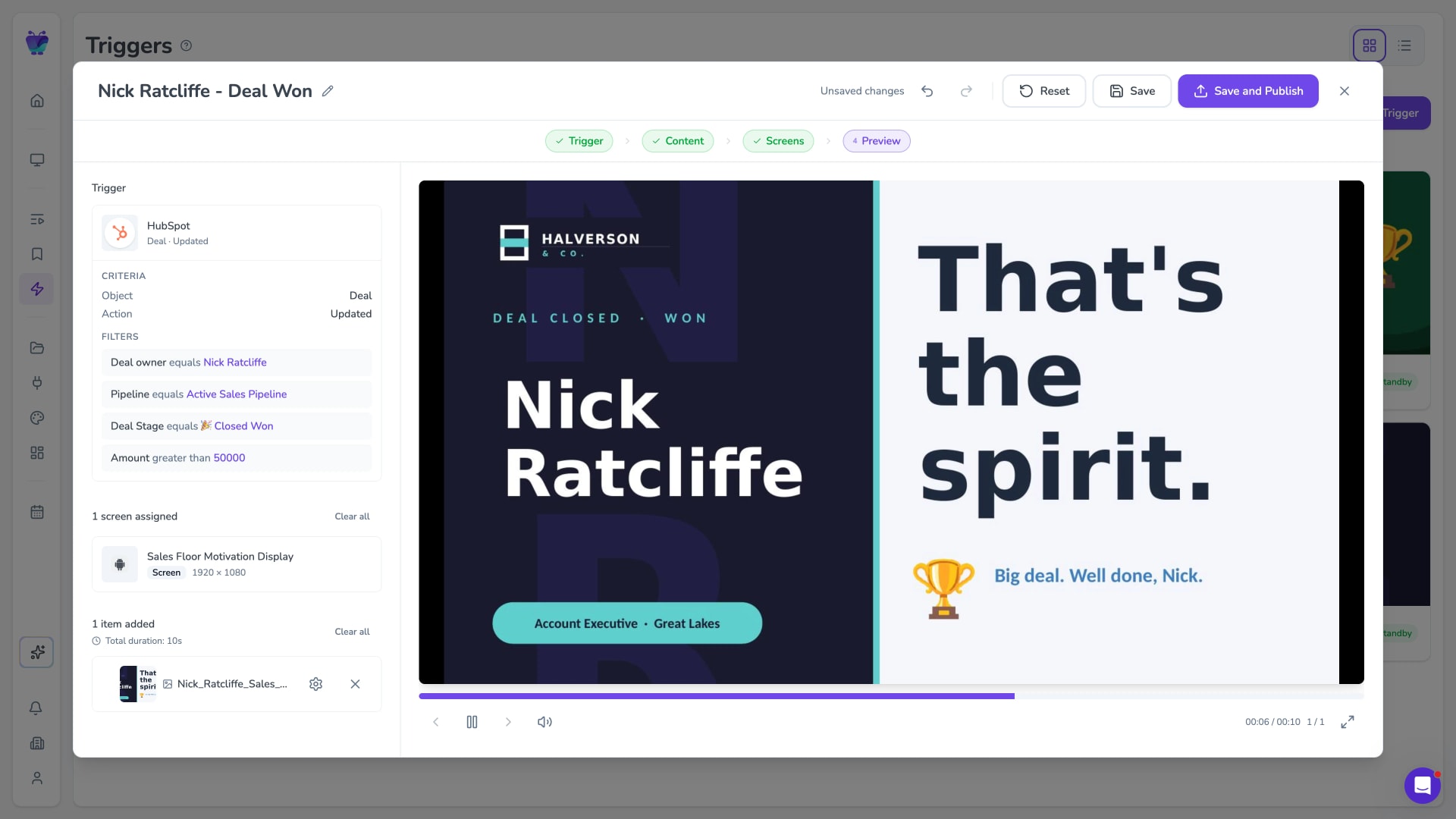
Automate content with triggers
Switch what plays based on data, schedules and events so screens react without anyone touching them.
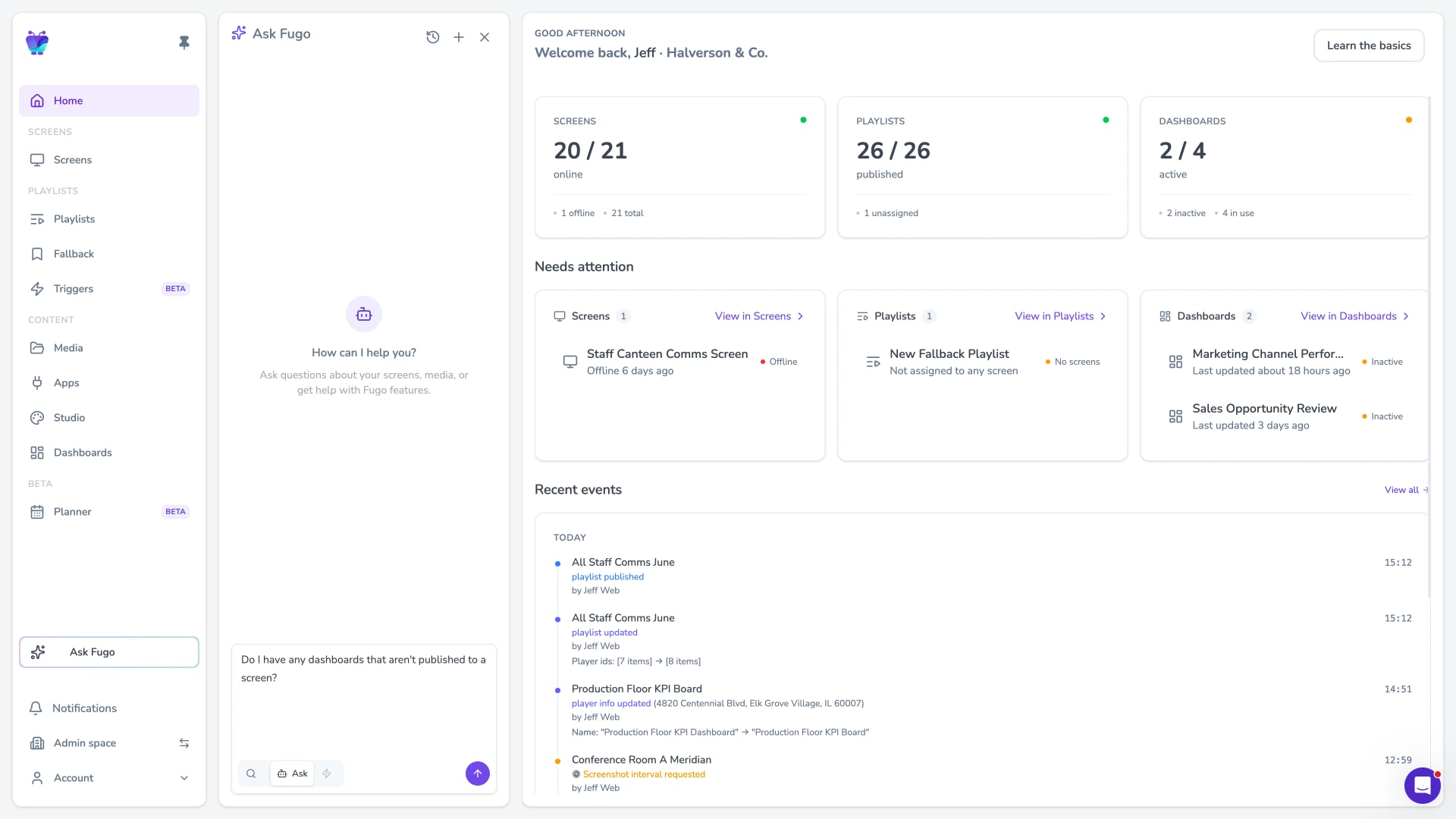
Ask Fugo to do the work
Type what you want in plain English and let Fugo find content, build layouts and take actions for you.
This is the actual Fugo dashboard
Not a screenshot that goes stale. This is the real screens page from the Fugo app, where you monitor and manage every player on your network.