







At 4 PM on a Friday afternoon, someone at your headquarters finalizes a new set of in-store promotions. Someone sends the link off to Slack, and people react with a few emojis. All that’s left is for your individual locations to put said creative on display.
But by the time you reach Wednesday of the following week, your once-uniform marketing now seems a little bit… unique.
One of your smaller locations still has screens showing off last month’s offer. Another tweaked the new content’s headline to “make it fit,” but ended up confusing a bunch of customers. A third location never even got the promotions out, because they weren’t aware they needed to print out physical flyers.
No one did anything wrong here per se. But without the right safeguards, it’s easy for signage to become out-of-sync between locations. Even if a message starts as a unified item, the unintentional game of telephone slowly breaks it apart (more on this later).
And in high-risk industries like retail and hospitality, it won’t take long for discrepancies to add up.
The good news is, we have some solutions.
Here are some ways to synchronize your in-store marketing, plus an easy solution you can implement free for 14 days.
But first, what messes up in-store marketing in the first place?

Have you ever heard of the game of telephone?
One person whispers a message to someone sitting next to them, before that person repeats the same message to the next person in line. Since it passes through so many people, there’s a very good chance the meaning has changed by the end. No one intended to get it wrong (most of the time). But the system designed to transport the message just wasn’t designed to preserve accuracy at scale. 👀
In-store marketing promotions often break down the same way. As messages move from HQ to regional managers and store teams, it can create friction, incorrect interpretations, and publishing delays. The more locations you add, the longer that chain becomes, and the harder it is to keep in-marketing intact.
So, what are the most common system breakdowns affecting your in-store marketing?
- Rapid store expansion. What once worked with a handful of locations starts to fall apart when dozens of stores need the same update at the same time. You also need to consider different time zones, staffing differences, and building size.
- Local team problems. Store managers generally have more to worry about than just in-store marketing collateral (think: unhappy customers, issuing refunds, or dealing with building maintenance). So when there are no clear instructions, they might need to make in-the-moment judgment calls to keep things running. Yes, even if it means adjusting, replacing, or foregoing HQ messaging.
- Weak communication chains. When everyone’s responsible for your in-store marketing, no one is. If managers don’t know who’s in charge of making updates or reporting problems, it could lead to missed, delayed, or misinterpreted promotional efforts.
- Tool sprawl. Email and PDFs and shared drives, oh my! If you’re relying on USBs and legacy signage systems to keep your promotional signage afloat, it could quite literally be creating bloat that makes consistency harder to follow.
The not-so-pretty side effects of inconsistent in-store marketing
Inconsistent in-store marketing is a very bad look, no matter who you are or what industry you’re in.
To the customer visiting your locations, it may be a signal of untrustworthiness.
To your in-store teams, it can lead to inconsistent sales (if not bad reviews).
And to the folks at HQ, it could be a PR nightmare — or a very expensive budget item that does nothing to support your business’s growth.
Let’s break down all three categories.
For customers
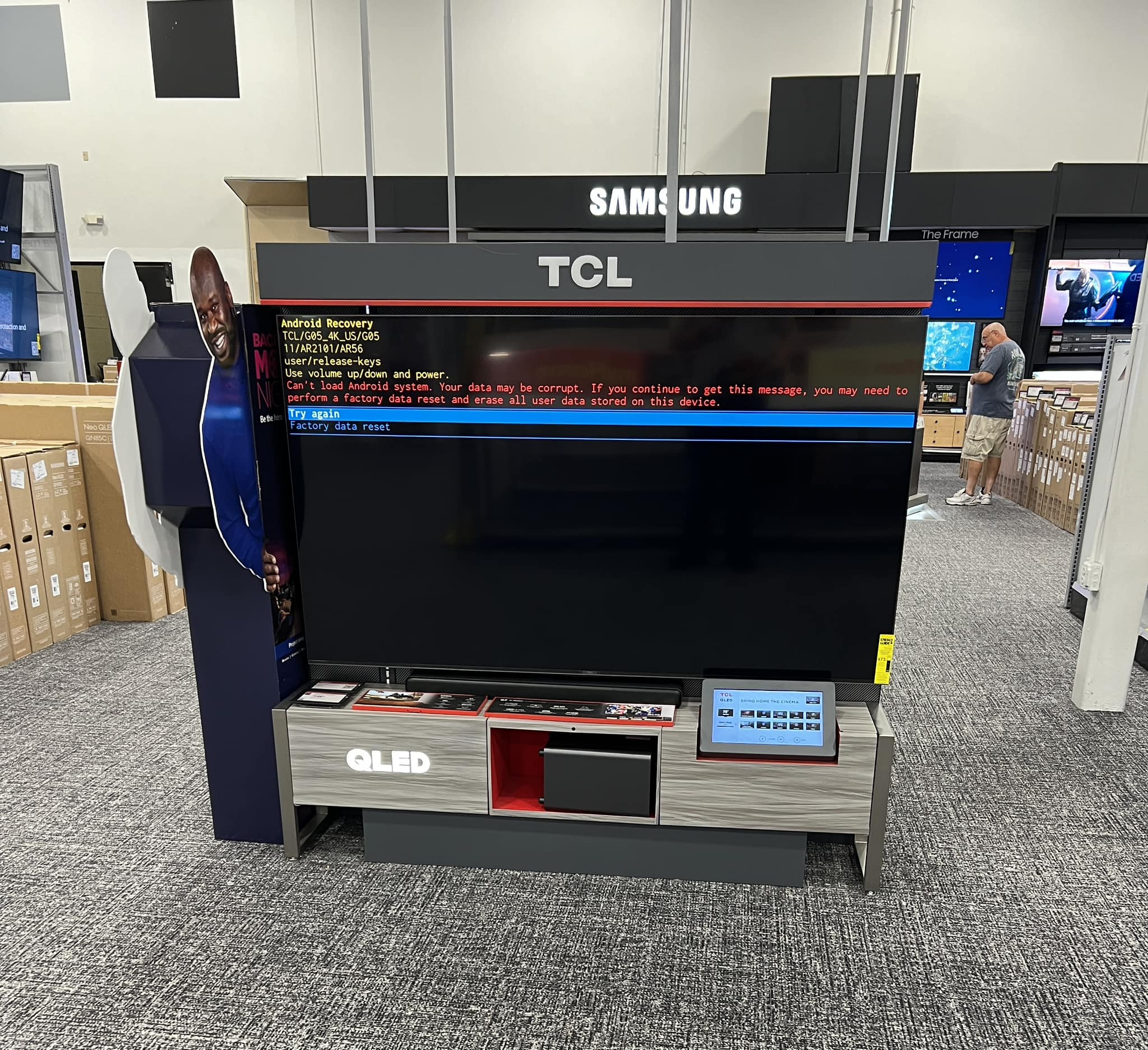
Customers are (obviously) the first group to experience the effects of misaligned in-store marketing. They’ll also be the first to notice when a store’s promotions don’t match what they saw online, when prices vary from screen to screen, or when a staff member mentions something that doesn’t appear anywhere else in the store.
These many conflicting messages may create hesitation during times when customers should feel confident, curious, or ready to purchase something. Plus, outdated or expired offers lingering on displays could lead to returns or putbacks (not to mention a slightly less positive brand image).
Over time, inconsistent in-store marketing can chip away at customer trust, which eventually results in fewer sales and poorer word of mouth.
For store locations and team members
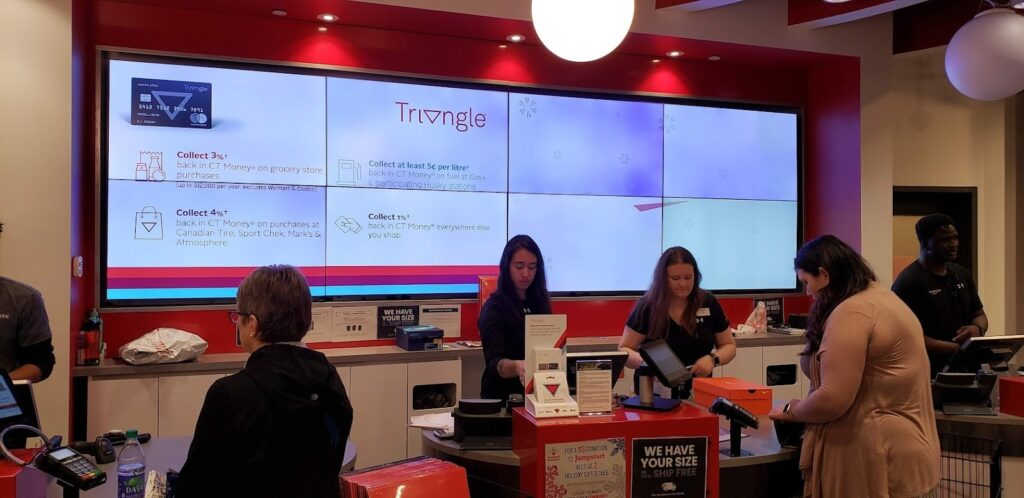
As mentioned, most store managers get caught between HQ directives and the realities of running a real-life store. Everyone looks to them whenever things go wrong. When assets arrive late, or trucks don’t arrive as expected, their attention will obviously turn toward the next (biggest) fire to put it.
It goes without saying that your ‘middle management’ folks with boots on the ground probably won’t have much time to spend on fixing in-store signage issues. But we also know this has a trickle-down effect:
- Marketing teams can’t be sure campaigns are being displayed correctly
- Operations and IT may need to spend ad-hoc time fixing screens, checking for updates, and troubleshooting last-minute issues
- Compliance teams have very little information about what’s live, where it’s live, and whether it should be
And we haven’t even talked about its effect on frontline teams yet, like mismatched specials or miscommunications about weekly promos.
For HQ
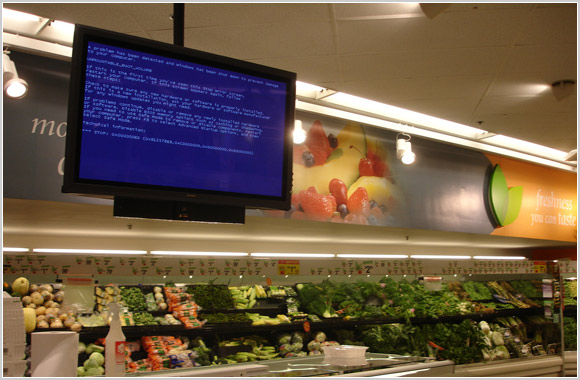
At the leadership level, aka your business headquarters, misaligned in-store marketing can quickly turn into a compounding operational drag. Without the right systems in place for signage, it might take much longer to roll out new campaigns. Plus, internal teams may end up spending time and budget on rework (think manual updates, last-minute fixes, and sending out follow-ups asking individual locations what happened).
There’s also quite a bit of up-front risk to the brand itself. For example, inconsistent messaging can dilute your brand, expose your team to lawsuits, or just plain look bad in the public limelight.

Over time, your team may end up wanting to settle for a ‘democratized’ signage process, even if it’s not the best solution for your team. That’s not necessarily because they want to, by the way, but because your existing system makes consistency hard to maintain.
How to restore your in-store marketing
We’ve already hinted at some of the solution, but it bears repeating: it starts with building a repeatable system.
Here’s exactly how to sync up your in-store marketing for every location managed under your HQ.
Real-time visibility into every promotion
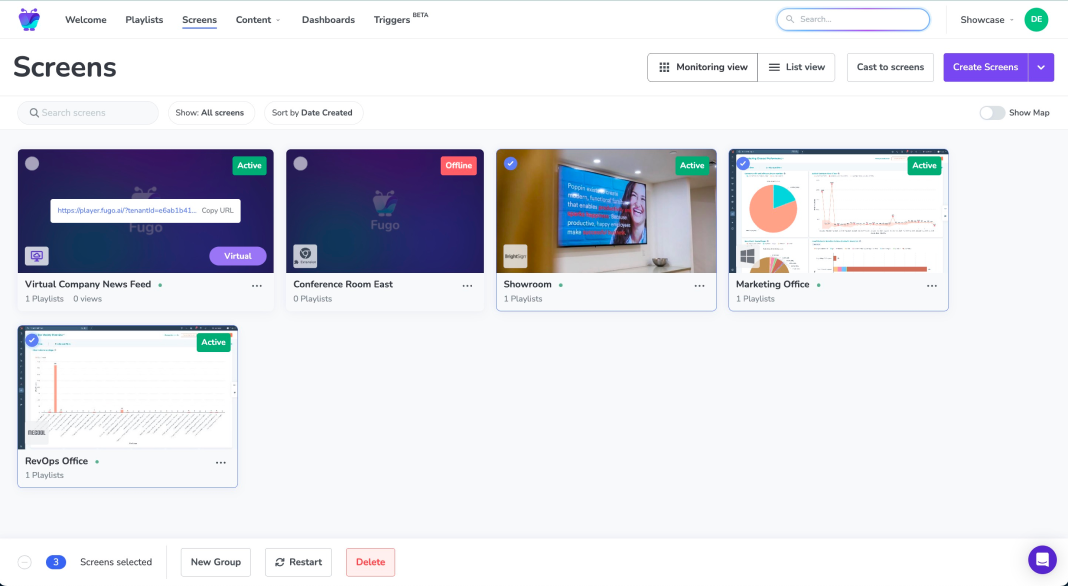
When your HQ has real-time visibility into what’s playing on every screen, there’s a lot less guesswork and a lot more uniformity.
The solution is using content management systems to schedule business-wide campaigns with fixed start and end dates. That way, you can set promotions to go live (and come down) automatically, without tasking your individual store managers with the job.
You can also allow local teams to layer in content. First, create branded templates for things like menus, promos, and announcements. Then, lock non-editable areas for things like compliance phrases or must-have imagery. This allows local teams to use approved regional or store-specific content without overriding the core message of your signage.
Now, you can see all your global signage content behind a single live dashboard. Everyone on your team (from HQ to the store floor) can see what’s getting displayed on your screens.
Ownership, approvals, and expiration rules
Who owns your in-store marketing promotions? HQ? Store managers? Or one specific person? Remember: if everyone in your business ‘kind of’ owns content, no one does. That’s how outdated promos and “temporary” slides keep surviving audit rounds.
The fix here is defining ownership the same way you would for social or email marketing.
Start by separating roles:
- Creators build content using approved templates
- Approvers sign off on brand, pricing, or compliance
- Publishers control when and where content goes live
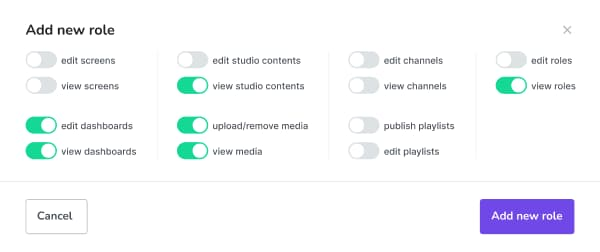
In Fugo, a digital signage CMS, you get to decide which users have which abilities by toggling accessibility on and off. Should your local stores be able to publish and edit playlists? Or just publish them? You can even lock down who uploads or removes media so you don’t need to worry about losing content.
Another pro tip: document the ownership of your in-store marketing in some publicly accessible place. Each campaign, medium, or asset type should have a dedicated resource page explaining who owns and approves it (like a Notion page or an Airtable). That way, when people change roles or leave a store location, you can easily reassign ownership without risking knowledge loss or a security breach.
Using a CMS and digital signage instead of physical signage
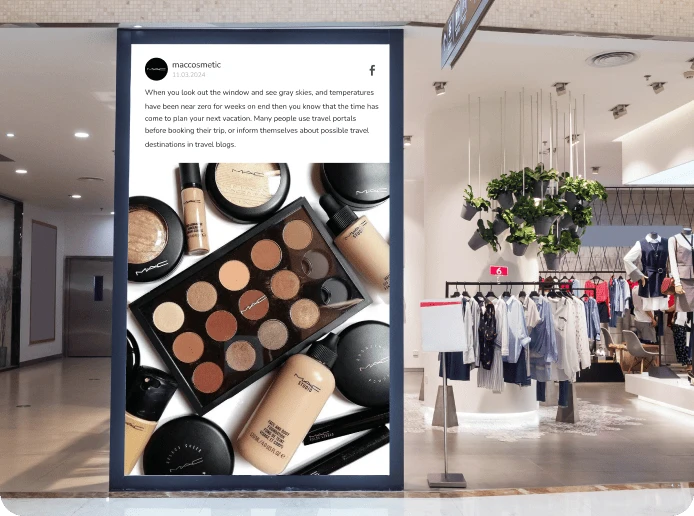
In-store marketing is a living communication channel. And the most effective method of communicating through said channel is by leaning on digital signage.
It’s not hard to see why.
Digital signage is persistent, visual, and unavoidable — in the very best way, of course. If something’s wrong with your promotions, you can see the problem immediately. And if something needs to change, the update can be instantaneous (so long as you have a CMS, that is). There’s also no question about which promotional version is correct, because your screen and content repository serve as a single source of truth.
Whether you already have a digital signage program or have been on the fence for a while, you need the following elements in place to solve inconsistencies with your in-store marketing:
- Use cloud-based signage tools. This allows HQ to manage campaigns centrally while still accounting for location, screen type, and audience.
- Create rise and repeat content playlists. Build playlists once, then reuse them across stores. You can also set rules for timing, layout, and content priority.
- Set up third-party integrations. And not necessarily for the weather or local news. With Fugo, you can connect to company intranets, on-prem data, and more to simplify promotions and content management workflows. Our team can also work alongside you with project scoping and development.
Now, that’s not to say traditional paper/pencil promotions aren’t still viable. They’re just significantly harder to manage compared to digital assets.
And with Fugo by your side, you can easily digitize the promotions you already have, and change content within seconds (aka, no peeling paper off your windows or falling over cables while switching USB drives).
Fugo makes it easy to keep in-store marketing in sync with enterprise digital signage features that grow alongside your team.
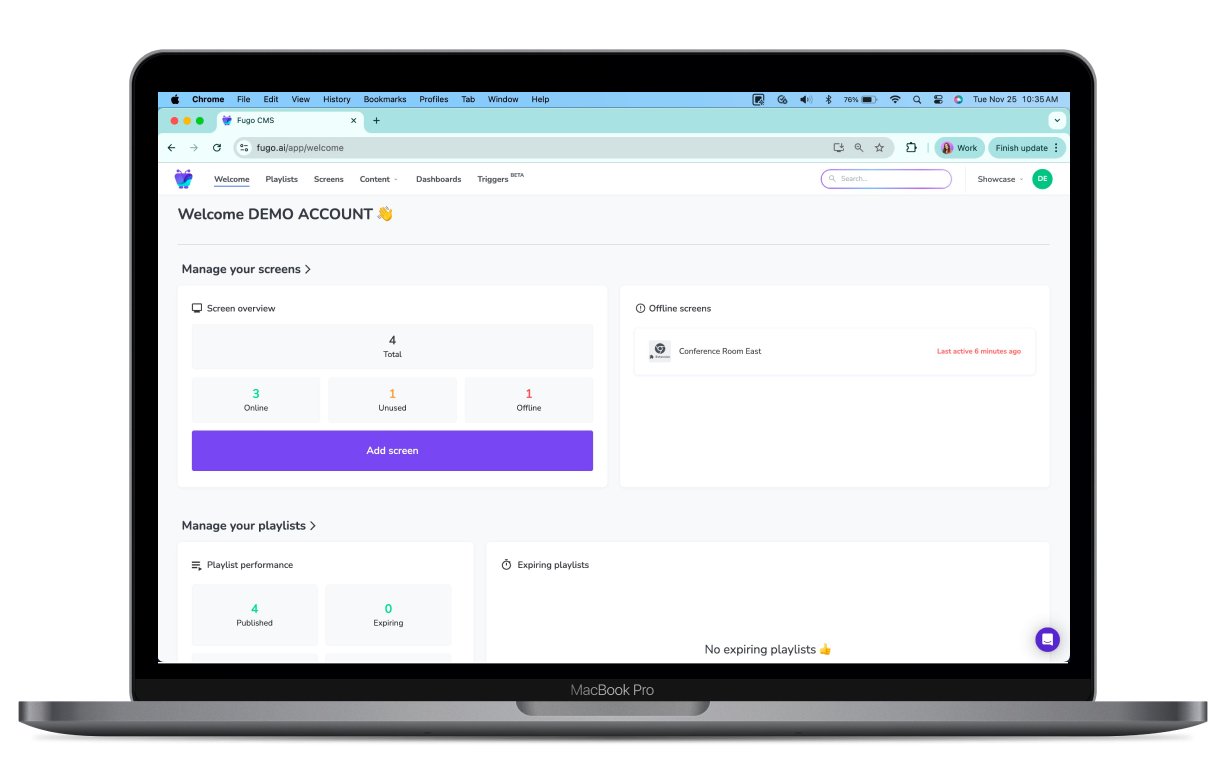
No need to take our word for it, though.
Experience Fugo yourself by signing up for a 14-day free trial.
Frequently asked questions about de-synced in-store marketing
Q: How does digital signage help in retail?
Digital signage helps retailers create in-store marketing and promotions across multiple countries and locations. You can also use signage screens to display pricing, wayfinding, and internal communications like PTO requirements or holiday hours. Some digital signage software, like a content management system (CMS), can help you manage all this without any manual updates.
Q: What is digital marketing in retail in-store marketing?
Digital in-store marketing uses screens and interactive displays to deliver targeted messages inside physical locations. Apart from traditional retail environments, you can also use in-store marketing in hotels, restaurants, and certain healthcare environments.
Q: What is in-store marketing?
In-store marketing refers to the tactics used inside a physical location to guide, inform, and persuade customers into taking specific actions. This can range from digital signage displays to paper promotions, display layouts, and interactive kiosks.
Q: What is the purpose of in-store signage?
The goal of in-store signage is to communicate the right information to the right people at the right time. For customers, this makes it easier to see what’s on sale, plus coupons available to help save money. For retailers, this could help to drive more sales and increase profits.

