
Fugo

LG webOS digital signage software

Run Fugo directly on LG webOS Signage commercial displays — no external player. Install by URL and manage every screen from the cloud.

LG webOS Signage video wall behind a corporate reception desk showing a continuous welcome message
Why LG webOS Signage

Built for professional, always-on displays

LG commercial signage displays run webOS Signage on a built-in system-on-chip (SoC) — distinct from consumer webOS TVs. Higher brightness, longer operating hours, and greater durability make them ideal for professional deployments.

No external player

Fugo runs on the display’s built-in system-on-chip, so there’s no media box, stick, or PC to buy, mount, or maintain. That means fewer points of failure per screen and a tidier install with nothing hidden behind the panel. One display is the whole signage endpoint.

Clean install by URL

Push the Fugo app straight to the display from a URL using LG’s SI Server setting — no USB sticks or manual sideloading. Because the IPK is pulled over the network, you can provision new panels the same way every time. Remote app updates then keep every screen on the current build.

Commercial 24/7 operation

LG webOS Signage panels are engineered for continuous, always-on use — not the 4–6 hour sessions consumer TVs are built for. Higher brightness keeps content legible in bright lobbies and storefronts, and the hardware is rated for the long duty cycles signage demands.

Energy efficient

Commercial displays are designed for lower power draw across long operating hours, which keeps running costs down as you scale. Over a fleet of always-on screens, that efficiency compounds into a meaningfully lower total cost of ownership than repurposed consumer hardware.

Supported models

LG webOS signage models Fugo supports

Fugo runs on webOS Signage OS 4.0, 4.1, and 6.0. webOS 6.0 is strongly recommended; 4.0 is supported but not recommended.

Recommended — webOS 6.0

  • UH7J series
  • UH5J series
  • Strongly recommended firmware

Recommended — webOS 4.1

  • UH5F-H
  • UH7F-H
  • VSM5J-H
  • LG One Quick Flex

Supported, not recommended

  • UM3DG-B
  • VM5J-H
  • VH7E-H (discontinued)
  • UL3G (discontinued)
  • webOS Signage 4.0
Setup

Install Fugo on LG webOS signage

Push the Fugo app to your display from a URL, then pair it in Fugo CMS.

Fugo CMS screen settings basic tab showing screen identity and system details
1

Confirm the unit and set time & date

Open General → System Information and check the model is a Signage unit, not a consumer TV. Then set the correct Time & Date under General settings — the app install fails if the clock is wrong, so this step is essential before you go any further.

Fugo CMS screen settings advanced tab showing media and playback configuration
2

Enter the Fugo install URL

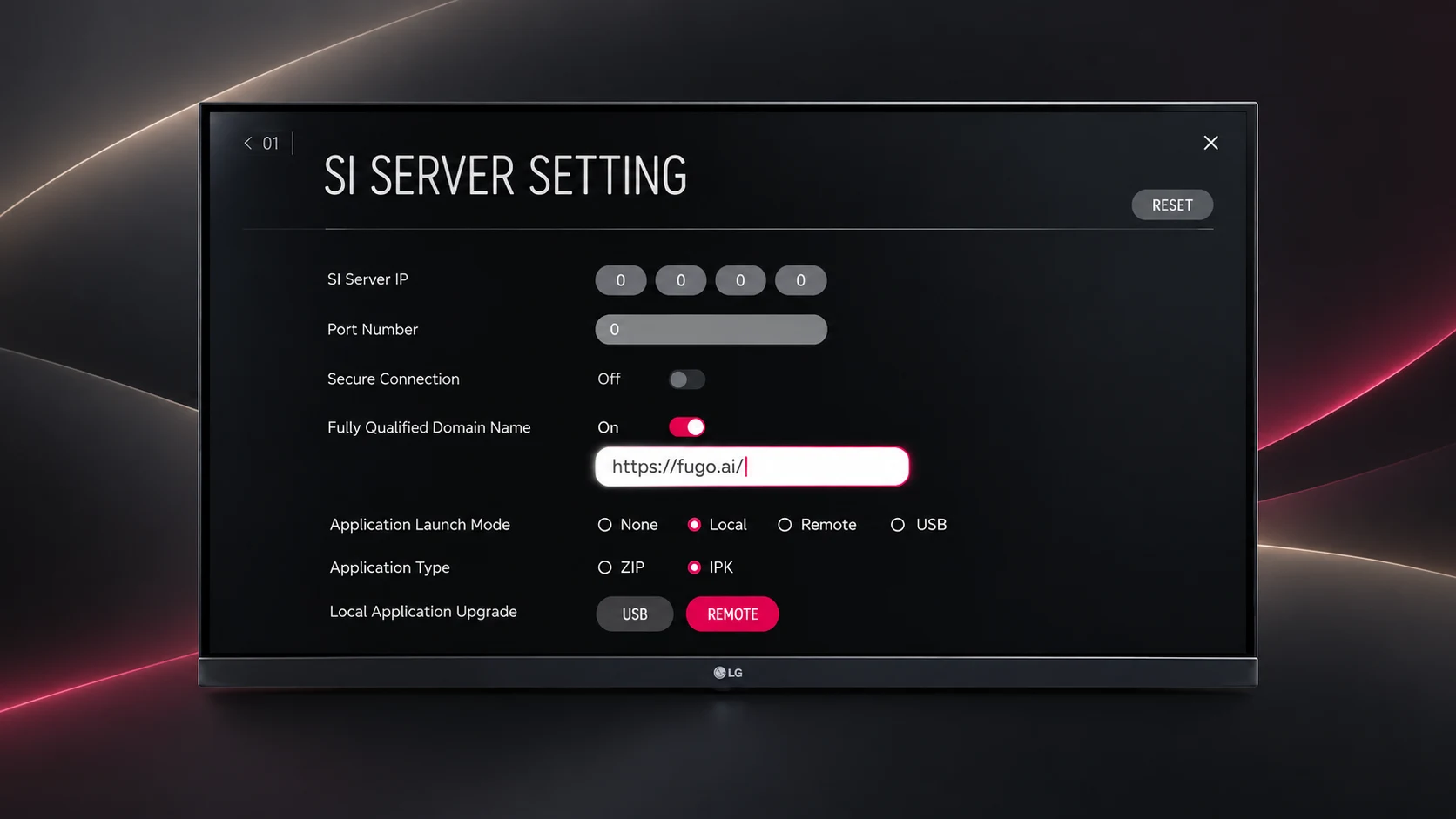
On the remote, open Settings → Ez Settings → SI Server Setting. Enable Fully Qualified Domain Name, enter https://fugo.ai/fugo.ipk as the app URL, and press Enter to save it. This tells the display where to pull the Fugo IPK from.

Fugo CMS screen settings platform tab showing player and platform configuration
3

Run the local application upgrade

Under Local Application Upgrade, choose Local → IPK → Remote and confirm. The display downloads and installs the Fugo IPK from the URL you entered. When it finishes you’ll see an “Upgrade Complete” message in the top right.

Fugo CMS screen pairing modal ready to receive a pairing PIN
4

Restart and pair

Restart the display and Fugo boots automatically, showing a pairing PIN on screen. Enter that PIN in Fugo CMS to connect the screen to your account. If “Complete” shows but the app doesn’t appear, recheck the Time & Date setting and run the install again.

Fugo software

A full digital signage software suite on every LG display

The LG panel handles reliable, always-on playback while Fugo CMS gives you everything you need to design, schedule, and manage content across your whole network from the cloud.

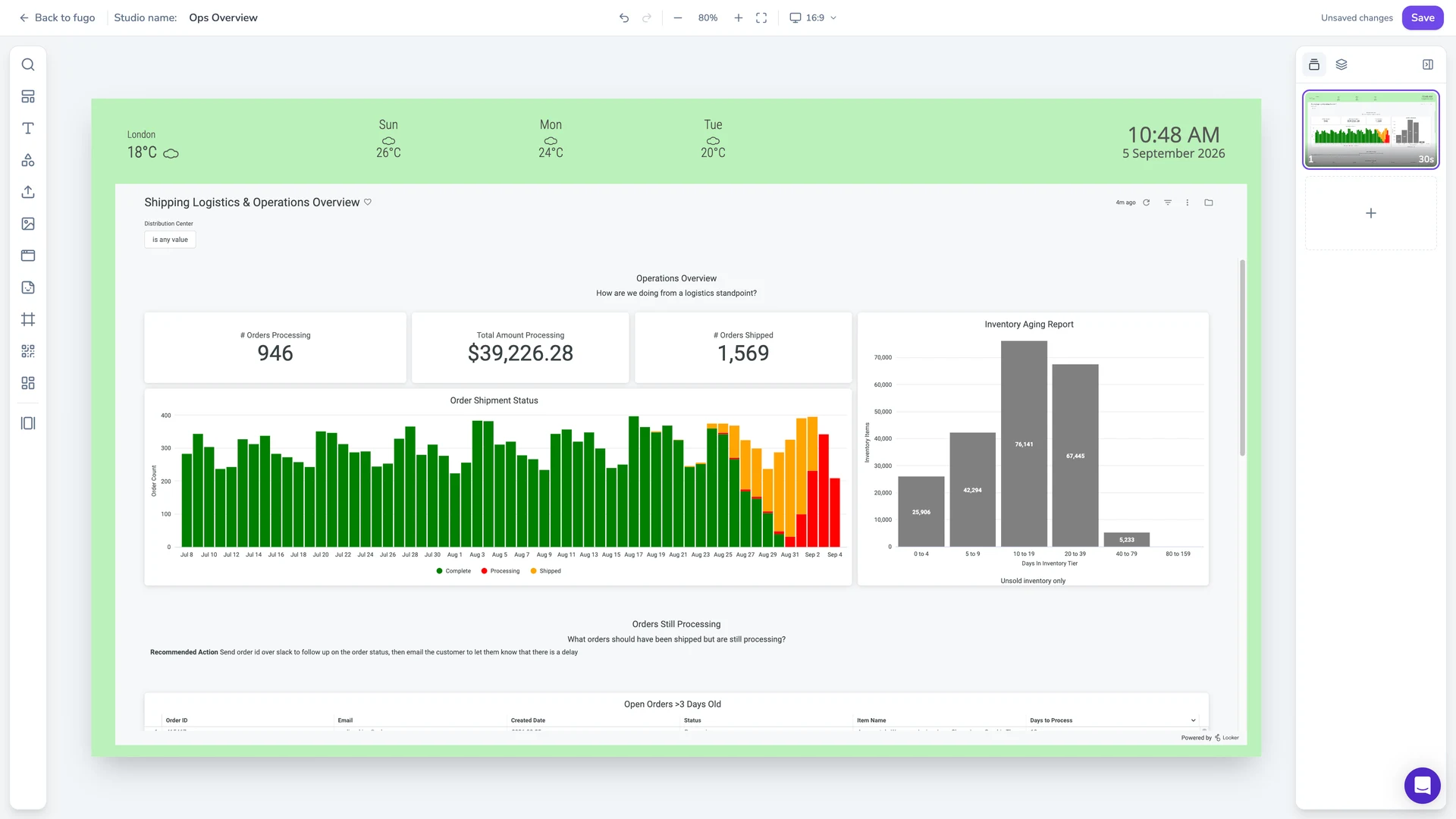
Fugo Design Studio with a blank landscape canvas ready for content

Design content without leaving Fugo

Build screen-ready posters, menu boards, and welcome screens in the browser-based Design Studio. Start from an industry template or a blank canvas, then drop in text, media, and live apps — no third-party design tool required.

Fugo CMS screens page with displays grouped by property for central management

Manage every screen from one place

Group, tag, and monitor all your LG displays from a single cloud dashboard. See which screens are online at a glance and push content to a whole location or property group at once, without ever touching the hardware.

Fugo CMS playlist scheduling with start and end dates set

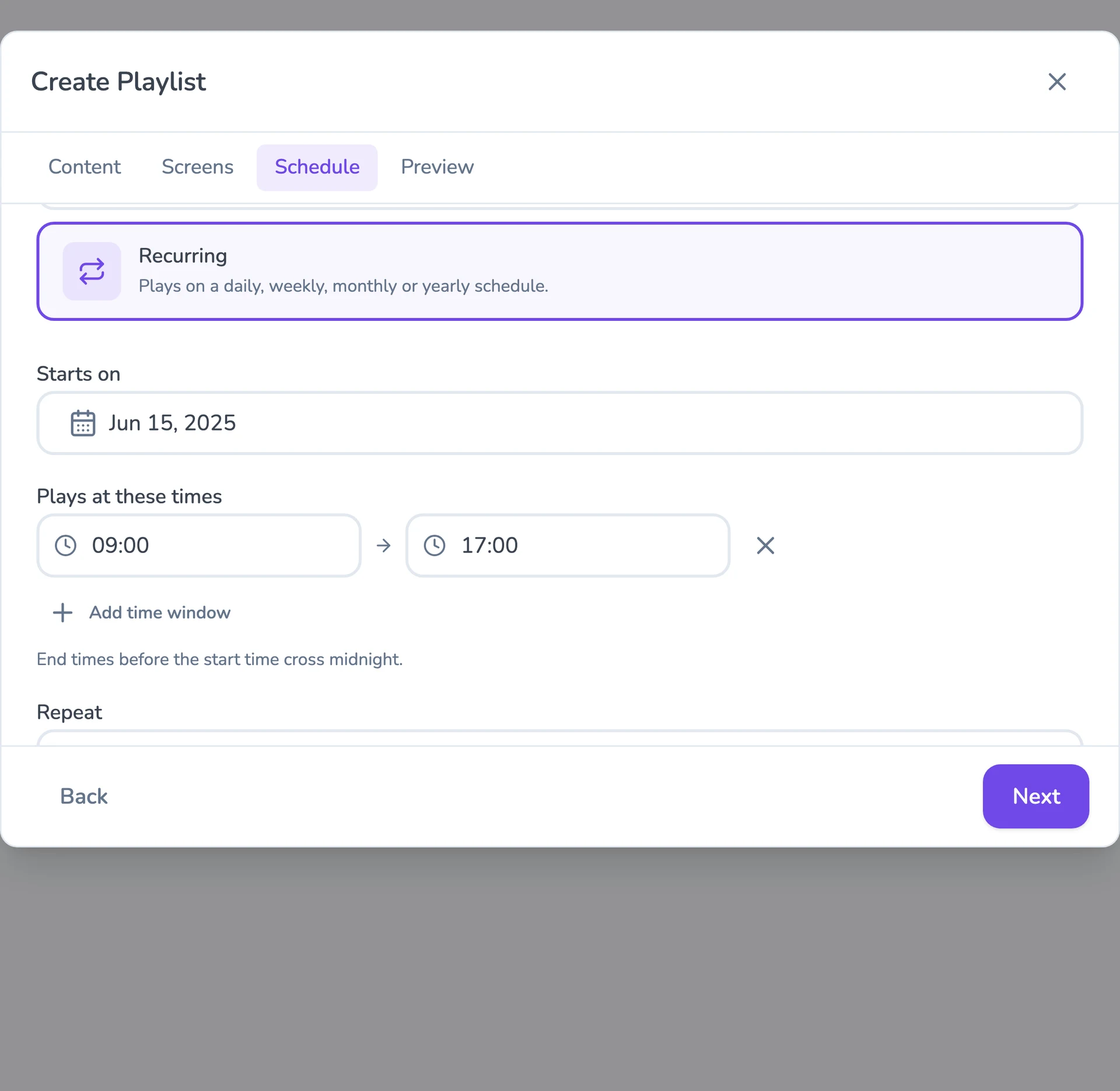
Schedule content ahead of time

Set start and end dates so promotions, seasonal campaigns, and announcements go live and expire on their own. Recurring schedules and priority takeovers keep planning simple while making sure the right message is always on screen.

Fugo App Store showing integrations and data apps available for signage

Add apps, dashboards, and data

Pull in weather, news, social walls, and live TV dashboards from Power BI, Tableau, Looker, and more through the Fugo App Store. Content stays fresh automatically, so your LG screens show up-to-date information without manual updates.

Signage vs consumer TV

Use a signage unit, not a consumer LG TV

Fugo must run on a webOS Signage unit. Consumer webOS TVs are built for short 4–6 hour viewing sessions and aren’t fit for always-on signage.

LG webOS signage

Commercial panels built for continuous, professional use, with higher brightness, longer operating hours, and greater durability than a consumer set. They run the webOS Signage operating system and support the SI Server install path Fugo uses, so they’re the right choice for any always-on deployment.

Consumer webOS TV

Designed for 4–6 hours of home viewing a day, consumer webOS TVs aren’t built for always-on signage and aren’t supported for Fugo installs. If you’re not sure which you have, open General → System Information — a signage unit will mention “Signage” there.

Media & features

Everything you can play on an LG display

Standard media plus PNG support, in landscape or portrait, with multi-zone layouts and cloud-managed apps.

Landscape and portrait

Run content in either orientation to suit the panel and the space. Multi-zone layouts split the screen into regions and can play up to two concurrent videos or live streams on a single display, so you can pair a menu with a promo or a dashboard with a news ticker.

App store apps and webpages

Show live apps, web pages, and images and video (JPEG, PNG, WebP, GIF, MP4, MOV, and more) alongside your own media. Everything is scheduled and updated centrally from Fugo CMS, so a change you make in the cloud lands on the LG screen automatically.

Offline media and remote updates

Cached media keeps playing even if the network drops, so a screen is never blank. Remote screenshot monitoring lets you confirm what’s on each display, and remote Fugo app updates roll out fixes and features without a single site visit.

LG webOS digital signage FAQs

Which LG displays does Fugo support?

Fugo runs on LG webOS Signage displays on webOS Signage OS 4.0, 4.1, and 6.0. We strongly recommend webOS 6.0 (UH7J and UH5J series) or 4.1 (UH5F-H, UH7F-H, VSM5J-H, and LG One Quick Flex). See the LG hardware directory for the full list.

Do I need an external player for LG signage?

No. LG webOS Signage displays have a built-in system-on-chip that runs Fugo directly. There’s no media box, stick, or PC to buy or maintain — you install Fugo straight onto the display.

Can I use a consumer LG TV for digital signage?

No. Fugo must run on a webOS Signage unit. Consumer webOS TVs are built for 4–6 hour viewing sessions and aren’t fit for always-on signage. Confirm your unit is a Signage model under System Information before installing.

How do I install Fugo on an LG webOS signage display?

Set the correct Time & Date, then go to Settings → Ez Settings → SI Server Setting, enable Fully Qualified Domain Name, and enter https://fugo.ai/fugo.ipk. Run the Local Application Upgrade (Local → IPK → Remote), restart, and Fugo boots automatically with a pairing PIN. Full steps are in the install guide.

The install shows “complete” but Fugo doesn’t appear — what now?

This usually means the display’s Time & Date is wrong. Recheck and correct it under System settings, then run the install again. If you’re testing, there’s also an easier alternate install path in the LG help centre (article 6359068).

Which media and file types can LG webOS signage play?

LG webOS Signage supports the standard signage formats: images (JPEG, JPEG 2000, PNG, WebP, SVG, GIF), video (MP4, MPG, MPEG, MOV, AVI), MP3 audio, and PDF documents. You can also show live web pages, App Store apps, and TV dashboards. See the LG hardware directory for the full list of supported media and features.

Can LG signage run in portrait, and can it show more than one thing at once?

Yes. LG webOS Signage displays support both landscape and portrait orientation, and Fugo’s multi-zone layouts can play up to two concurrent videos or live streams on a single screen — for example a menu next to a promo, or a dashboard beside a news feed.

Can I manage and update LG displays remotely?

Yes. Every LG display connects to Fugo CMS in the cloud, so you can group screens, schedule content, and push changes from anywhere. Fugo also supports remote screenshot monitoring to confirm what’s on each screen and remote application updates, so you rarely need to visit the display in person.